Back
Back
Problem 12.4.91
90–94. Focal chords A focal chord of a conic section is a line through a focus joining two points of the curve. The latus rectum is the focal chord perpendicular to the major axis of the conic. Prove the following properties.
Let L be the latus rectum of the parabola y ² =4px for p>0. Let F be the focus of the parabola, P be any point on the parabola to the left of L, and D be the (shortest) distance between P and L. Show that for all P, D+|FP|+ is a constant. Find the constant.
Problem 12.3.33
33–40. Areas of regions Make a sketch of the region and its bounding curves. Find the area of the region.
The region inside the curve r = √(cos θ)
Problem 12.1.114
Second derivative Assume a curve is given by the parametric equations x=f(t) and y=g(t), where f and g are twice differentiable. Use the Chain Rule to show that y″x=(fʹ(t)g″(t) − gʹ(t)f″(t))/(fʹ(t))³.
Problem 12.1.86
81–88. Arc length Find the arc length of the following curves on the given interval.
x = 2t sin t - t² cos t, y = 2t cos t + t² sin t; 0 ≤ t ≤ π
Problem 12.2.60
57–64. Graphing polar curves Graph the following equations. Use a graphing utility to check your work and produce a final graph.
r² = 4 sin θ
Problem 12.3.1
Express the polar equation r=f(θ) in parametric form in Cartesian coordinates, where θ is the parameter.
Problem 12.1.65
Air drop—inverse problem A plane traveling horizontally at 100 m/s over flat ground at an elevation of 4000 m must drop an emergency packet on a target on the ground. The trajectory of the packet is given by
x = 100t, y = −4.9t² + 4000, t ≥ 0
where the origin is the point on the ground directly beneath the plane at the moment of the release. How many horizontal meters before the target should the packet be released in order to hit the target?
Problem 12.2.56
53–56. Simple curves Tabulate and plot enough points to sketch a graph of the following equations.
r = 1 - cos θ
Problem 12.2.13
9–13. Graph the points with the following polar coordinates. Give two alternative representations of the points in polar coordinates.
(-4, 3π/2)
Problem 12.4.43
39–50. Equations of ellipses and hyperbolas Find an equation of the following ellipses and hyperbolas, assuming the center is at the origin.
An ellipse with vertices (±5, 0), passing through the point (4, 3/5)
Problem 12.4.94
90–94. Focal chords A focal chord of a conic section is a line through a focus joining two points of the curve. The latus rectum is the focal chord perpendicular to the major axis of the conic. Prove the following properties.
The length of the latus rectum of a hyperbola centered at the origin is (2b²)/a = 2b√(1 - e²)
Problem 12.4.12
How does the eccentricity determine the type of conic section?
Problem 12.2.37
37–48. Polar-to-Cartesian coordinates Convert the following equations to Cartesian coordinates. Describe the resulting curve.
r cos θ = -4
Problem 12.3.22
Tangent line at the origin Find the polar equation of the line tangent to the polar curve r=4cosθ at the origin. Explain why the slope of this line is undefined.
Problem 12.2.28
25–30. Converting coordinates Express the following polar coordinates in Cartesian coordinates.
(2, 7π/4)
Problem 12.3.8
Without calculating derivatives, determine the slopes of each of the lines tangent to the curve r=8 cos θ−4 at the origin.
Problem 12.2.4
What is the polar equation of a circle of radius √(a²+b²) centered at (a, b)?
Problem 12.4.50
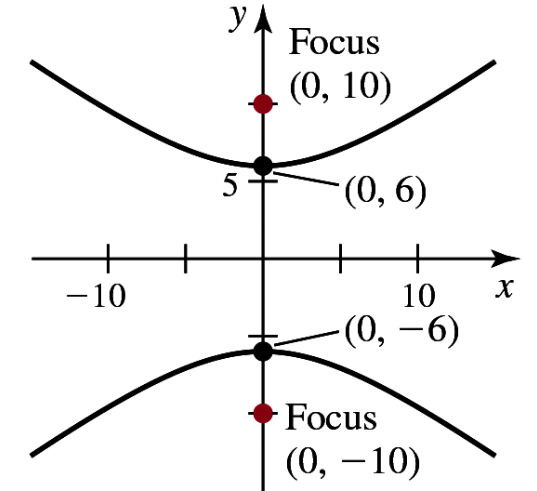
39–50. Equations of ellipses and hyperbolas Find an equation of the following ellipses and hyperbolas, assuming the center is at the origin.
Problem 12.3.37
33–40. Areas of regions Make a sketch of the region and its bounding curves. Find the area of the region.
The region inside the limaçon r = 2 + cos θ
Problem 12.2.79
Circles in general Show that the polar equation
r² - 2r r₀ cos(θ - θ₀) = R² - r₀²
describes a circle of radius R whose center has polar coordinates (r₀, θ₀)
Problem 12.1.15
15–30. Working with parametric equations Consider the following parametric equations.
a. Eliminate the parameter to obtain an equation in x and y.
b. Describe the curve and indicate the positive orientation.
x = 3 + t, y = 1 − t; 0 ≤ t ≤ 1
Problem 12.2.6
What is the polar equation of the horizontal line y = 5?
Problem 12.2.18
15–22. Sets in polar coordinates Sketch the following sets of points.
2 ≤ r ≤ 8
Problem 12.4.58
57–62. Polar equations for conic sections Graph the following conic sections, labeling the vertices, foci, directrices, and asymptotes (if they exist). Use a graphing utility to check your work.
r = 3/(2 + cos θ)
Problem 12.3.29
29–32. Intersection points Use algebraic methods to find as many intersection points of the following curves as possible. Use graphical methods to identify the remaining intersection points.
r = 2 cos θ and r = 1 + cos θ
Problem 12.4.71
69–72. Tangent lines Find an equation of the line tangent to the following curves at the given point.
y² - x²/64 = 1; (6, -5/4)
Problem 12.4.92
90–94. Focal chords A focal chord of a conic section is a line through a focus joining two points of the curve. The latus rectum is the focal chord perpendicular to the major axis of the conic. Prove the following properties.
The length of the latus rectum of the parabola y ² =4px or x ² =4py is 4|p|.
Problem 12.1.31
31–36. Eliminating the parameter Eliminate the parameter to express the following parametric equations as a single equation in x and y.
x=2 sin 8t, y=2 cos 8t
Problem 12.4.13
13–30. Graphing conic sections Determine whether the following equations describe a parabola, an ellipse, or a hyperbola, and then sketch a graph of the curve. For each parabola, specify the location of the focus and the equation of the directrix; for each ellipse, label the coordinates of the vertices and foci, and find the lengths of the major and minor axes; for each hyperbola, label the coordinates of the vertices and foci, and find the equations of the asymptotes.
x² = 12y
Problem 12.1.25
15–30. Working with parametric equations Consider the following parametric equations.
a. Eliminate the parameter to obtain an equation in x and y.
b. Describe the curve and indicate the positive orientation.
x = r − 1, y = r³; −4 ≤ r ≤ 4