Ch.12 - Parametric and Polar Curves
Briggs - Calculus: Early Transcendentals 3rd Edition
Briggs3rd EditionCalculus: Early TranscendentalsISBN: 9780136847243Not the one you use?Change textbook
Chapter 12, Problem 12.3.37

33–40. Areas of regions Make a sketch of the region and its bounding curves. Find the area of the region.


The region inside the limaçon r = 2 + cos θ

Verified step by step guidance
1
First, understand the problem: we need to find the area of the region inside the lima\(\c\) con given by the polar equation \(r = 2 + \cos \theta\). This means we are looking for the area enclosed by this curve for \(\theta\) ranging from \(0\) to \(2\pi\).
Recall the formula for the area enclosed by a polar curve \(r(\theta)\) between angles \(\alpha\) and \(\beta\) is given by: \[ \text{Area} = \frac{1}{2} \int_{\alpha}^{\beta} r(\theta)^2 \, d\theta \]
In this problem, since the lima\(\c\) con is a closed curve traced once as \(\theta\) goes from \(0\) to \(2\pi\), set \(\alpha = 0\) and \(\beta = 2\pi\). Substitute \(r(\theta) = 2 + \cos \theta\) into the formula to get: \[ \text{Area} = \frac{1}{2} \int_0^{2\pi} (2 + \cos \theta)^2 \, d\theta \]
Next, expand the square inside the integral: \[ (2 + \cos \theta)^2 = 4 + 4 \cos \theta + \cos^2 \theta \] So the integral becomes: \[ \frac{1}{2} \int_0^{2\pi} \left(4 + 4 \cos \theta + \cos^2 \theta\right) d\theta \]
Finally, split the integral into three separate integrals and evaluate each one using known integral formulas for \(\cos \theta\) and \(\cos^2 \theta\). Remember to use the identity for \(\cos^2 \theta\): \[ \cos^2 \theta = \frac{1 + \cos 2\theta}{2} \] This will simplify the integration process.

Verified video answer for a similar problem:

This video solution was recommended by our tutors as helpful for the problem above.
Video duration:
3m
Was this helpful?

Key Concepts

Here are the essential concepts you must grasp in order to answer the question correctly.

Polar Coordinates and Graphing

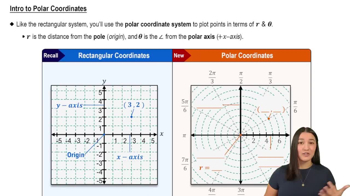
Polar coordinates represent points using a radius and an angle (r, θ). Understanding how to plot curves like the limaçon r = 2 + cos θ involves converting these polar equations into points and sketching the shape, which helps visualize the bounded region for area calculation.
Recommended video:
05:32
Intro to Polar Coordinates

Area Calculation in Polar Coordinates

The area enclosed by a polar curve r(θ) from θ = a to θ = b is given by the integral (1/2) ∫[a to b] (r(θ))^2 dθ. This formula accounts for the sector-like slices of the region, making it essential for finding areas bounded by curves defined in polar form.
Recommended video:
05:32
Intro to Polar Coordinates

Identifying Limits of Integration

Determining the correct interval for θ is crucial when integrating to find area. For a closed curve like the limaçon, the limits typically span one full period (0 to 2π), ensuring the entire region inside the curve is covered without overlap or omission.
Recommended video:
05:50
One-Sided Limits