Ch.12 - Parametric and Polar Curves
Briggs - Calculus: Early Transcendentals 3rd Edition
Briggs3rd EditionCalculus: Early TranscendentalsISBN: 9780136847243Not the one you use?Change textbook
Chapter 12, Problem 12.2.8

Given three polar coordinate representations for the origin.

Verified step by step guidance
1
Understand that the origin in polar coordinates is represented by the point where the radius \(r = 0\). This means the distance from the origin to the point is zero, regardless of the angle \(\theta\).
Recall that in polar coordinates, a point is given by \((r, \theta)\), where \(r\) is the radius (distance from the origin) and \(\theta\) is the angle measured from the positive x-axis.
Since the radius \(r = 0\) at the origin, the angle \(\theta\) can be any real number because the point is at the center and the direction does not affect its position.
Therefore, the three polar coordinate representations for the origin can be written as \((0, \theta_1)\), \((0, \theta_2)\), and \((0, \theta_3)\), where \(\theta_1\), \(\theta_2\), and \(\theta_3\) are any angles.
In summary, the key concept is that the origin in polar coordinates is always represented by \(r = 0\), and the angle \(\theta\) is arbitrary.

Verified video answer for a similar problem:

This video solution was recommended by our tutors as helpful for the problem above.
Video duration:
1m
Was this helpful?

Key Concepts

Here are the essential concepts you must grasp in order to answer the question correctly.

Polar Coordinates System

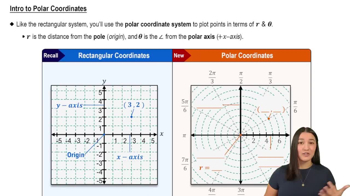
Polar coordinates represent points in a plane using a radius and an angle relative to a fixed direction, typically the positive x-axis. Each point is described by (r, θ), where r is the distance from the origin and θ is the angle measured in radians or degrees.
Recommended video:
05:32
Intro to Polar Coordinates

Multiple Representations of the Same Point

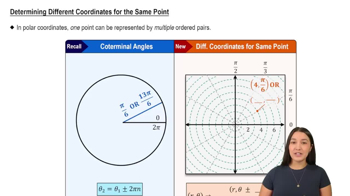
In polar coordinates, a single point can have multiple representations because adding or subtracting full rotations (2π radians) to the angle or using negative radius values can yield equivalent positions. For example, the origin (r=0) is represented by any angle θ.
Recommended video:
6:02
Determining Different Coordinates for the Same Point

The Origin in Polar Coordinates

The origin in polar coordinates is unique because its radius r is zero, making the angle θ arbitrary. This means the origin can be represented by infinitely many coordinate pairs (0, θ), highlighting the flexibility and special nature of the origin in this system.
Recommended video:
05:32
Intro to Polar Coordinates
Related Practice
Textbook Question

33–40. Areas of regions Make a sketch of the region and its bounding curves. Find the area of the region.


The region inside the curve r = √(cos θ)

Textbook Question

33–40. Areas of regions Make a sketch of the region and its bounding curves. Find the area of the region.


The region inside the limaçon r = 2 + cos θ

Textbook Question

15–30. Working with parametric equations Consider the following parametric equations.

a. Eliminate the parameter to obtain an equation in x and y.

b. Describe the curve and indicate the positive orientation.


x = 3 cos t, y = 3 sin t; π ≤ t ≤ 2π

Textbook Question

15–30. Working with parametric equations Consider the following parametric equations.

a. Eliminate the parameter to obtain an equation in x and y.

b. Describe the curve and indicate the positive orientation.


x = 3 + t, y = 1 − t; 0 ≤ t ≤ 1

1
views
Textbook Question

13–30. Graphing conic sections Determine whether the following equations describe a parabola, an ellipse, or a hyperbola, and then sketch a graph of the curve. For each parabola, specify the location of the focus and the equation of the directrix; for each ellipse, label the coordinates of the vertices and foci, and find the lengths of the major and minor axes; for each hyperbola, label the coordinates of the vertices and foci, and find the equations of the asymptotes.


x² = 12y

Textbook Question

63–74. Arc length of polar curves Find the length of the following polar curves.


The complete cardioid r = 4 + 4 sin θ