
Ch.12 - Parametric and Polar Curves
Briggs - Calculus: Early Transcendentals 3rd Edition
Briggs3rd EditionCalculus: Early TranscendentalsISBN: 9780136847243Not the one you use?Change textbook
Chapter 12, Problem 12.4.13

13–30. Graphing conic sections Determine whether the following equations describe a parabola, an ellipse, or a hyperbola, and then sketch a graph of the curve. For each parabola, specify the location of the focus and the equation of the directrix; for each ellipse, label the coordinates of the vertices and foci, and find the lengths of the major and minor axes; for each hyperbola, label the coordinates of the vertices and foci, and find the equations of the asymptotes.


x² = 12y

Verified step by step guidance
1
Identify the type of conic section by comparing the given equation \(x^{2} = 12y\) to the standard forms of conic sections. Since the equation involves a squared term in \(x\) and a linear term in \(y\), and it can be rewritten as \(x^{2} = 4py\), this suggests it is a parabola.
Rewrite the equation in the form \(x^{2} = 4py\) to find the parameter \(p\). Here, \(4p = 12\), so \(p = \frac{12}{4} = 3\). This parameter \(p\) represents the distance from the vertex to the focus and from the vertex to the directrix.
Determine the vertex of the parabola. Since the equation is in the form \(x^{2} = 4py\), the vertex is at the origin \((0,0)\).
Find the focus of the parabola. For \(x^{2} = 4py\), the focus is located at \((0, p)\), so here it is at \((0, 3)\).
Find the equation of the directrix. The directrix is a horizontal line given by \(y = -p\), so here it is \(y = -3\).

Verified video answer for a similar problem:

This video solution was recommended by our tutors as helpful for the problem above.
Video duration:
1m
Was this helpful?

Key Concepts

Here are the essential concepts you must grasp in order to answer the question correctly.

Identification of Conic Sections from Equations

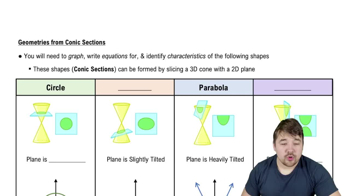
Conic sections are curves obtained by intersecting a plane with a cone, and their equations typically fall into standard forms. Recognizing whether an equation represents a parabola, ellipse, or hyperbola depends on the degree and arrangement of variables. For example, an equation with one squared term and one linear term, like x² = 12y, usually represents a parabola.
Recommended video:
3:08
Geometries from Conic Sections

Properties of Parabolas: Focus and Directrix

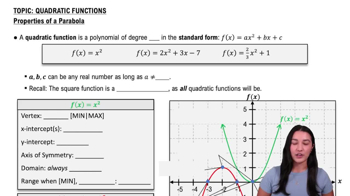
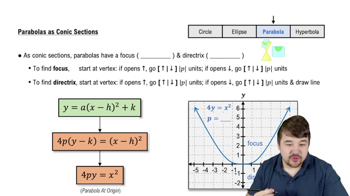
A parabola is defined as the set of points equidistant from a fixed point called the focus and a fixed line called the directrix. The vertex is the midpoint between the focus and directrix. For equations like x² = 4py, the focus is at (0, p) and the directrix is y = -p, where p is the distance from the vertex to the focus.
Recommended video:
7:42
Properties of Parabolas

Graphing Conic Sections and Key Features

Graphing conic sections involves plotting their key points such as vertices, foci, and asymptotes (for hyperbolas). For parabolas, sketching the axis of symmetry and marking the focus and directrix helps visualize the curve. Understanding these features aids in accurate graphing and interpretation of the conic's shape and orientation.
Recommended video:
5:33
Parabolas as Conic Sections