Ch.12 - Parametric and Polar Curves
Briggs - Calculus: Early Transcendentals 3rd Edition
Briggs3rd EditionCalculus: Early TranscendentalsISBN: 9780136847243Not the one you use?Change textbook
Chapter 12, Problem 12.1.15

15–30. Working with parametric equations Consider the following parametric equations.
a. Eliminate the parameter to obtain an equation in x and y.
b. Describe the curve and indicate the positive orientation.


x = 3 + t, y = 1 − t; 0 ≤ t ≤ 1

Verified step by step guidance
1
Identify the given parametric equations: \(x = 3 + t\) and \(y = 1 - t\), with the parameter \(t\) ranging from \(0\) to \(1\).
To eliminate the parameter \(t\), solve one of the equations for \(t\). For example, from \(x = 3 + t\), isolate \(t\) to get \(t = x - 3\).
Substitute the expression for \(t\) into the other equation: replace \(t\) in \(y = 1 - t\) with \(x - 3\), resulting in \(y = 1 - (x - 3)\).
Simplify the equation to express \(y\) solely in terms of \(x\): \(y = 1 - x + 3\), which simplifies further to \(y = 4 - x\).
Interpret the curve: the equation \(y = 4 - x\) represents a straight line. The parameter \(t\) increases from \(0\) to \(1\), so the curve starts at the point when \(t=0\) (which is \((3,1)\)) and ends at \(t=1\) (which is \((4,0)\)). This indicates the positive orientation of the curve is from \((3,1)\) to \((4,0)\).

Verified video answer for a similar problem:

This video solution was recommended by our tutors as helpful for the problem above.
Video duration:
3m
Was this helpful?

Key Concepts

Here are the essential concepts you must grasp in order to answer the question correctly.

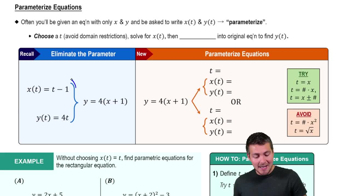
Parametric Equations

Parametric equations express the coordinates of points on a curve as functions of a parameter, usually denoted t. Instead of y as a function of x, both x and y depend on t, allowing the description of more complex curves and motions.
Recommended video:
Guided course
08:02
Parameterizing Equations

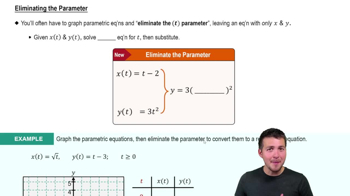
Eliminating the Parameter

Eliminating the parameter involves manipulating the parametric equations to remove t, resulting in a direct relationship between x and y. This often requires solving one equation for t and substituting into the other, yielding a Cartesian equation of the curve.
Recommended video:
Guided course
05:59
Eliminating the Parameter

Curve Orientation and Interval of Parameter

The orientation of a parametric curve is determined by the direction in which the parameter t increases. The interval for t specifies the portion of the curve traced, and understanding this helps describe the curve's direction and endpoints.
Recommended video:
02:59
Finding Area Between Curves that Cross on the Interval