
Ch.12 - Parametric and Polar Curves
Briggs - Calculus: Early Transcendentals 3rd Edition
Briggs3rd EditionCalculus: Early TranscendentalsISBN: 9780136847243Not the one you use?Change textbook
Chapter 12, Problem 12.2.18

15–22. Sets in polar coordinates Sketch the following sets of points.


2 ≤ r ≤ 8

Verified step by step guidance
1
Understand that the problem asks to sketch the set of points in polar coordinates where the radius \(r\) satisfies \(2 \leq r \leq 8\).
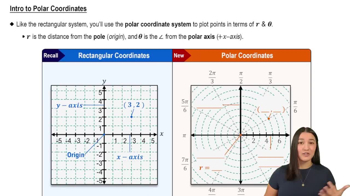
Recall that in polar coordinates, a point is represented as \((r, \theta)\), where \(r\) is the distance from the origin and \(\theta\) is the angle from the positive x-axis.
Since there is no restriction on \(\theta\), it means \(\theta\) can take any value from \(0\) to \(2\pi\) (or all angles around the origin).
The inequality \(2 \leq r \leq 8\) describes all points whose distance from the origin is at least 2 units and at most 8 units, forming a ring-shaped region (an annulus) between two circles of radii 2 and 8.
To sketch, draw two concentric circles centered at the origin: one with radius 2 and another with radius 8. The region between these two circles represents the set of points satisfying \(2 \leq r \leq 8\).

Verified video answer for a similar problem:

This video solution was recommended by our tutors as helpful for the problem above.
Video duration:
7m
Was this helpful?

Key Concepts

Here are the essential concepts you must grasp in order to answer the question correctly.

Polar Coordinates System

The polar coordinate system represents points in a plane using a radius and an angle, denoted as (r, θ). Here, r is the distance from the origin, and θ is the angle measured from the positive x-axis. Understanding this system is essential for interpreting and sketching regions defined by inequalities involving r and θ.
Recommended video:
05:32
Intro to Polar Coordinates

Inequalities in Polar Coordinates

Inequalities like 2 ≤ r ≤ 8 describe regions in the plane where the radius r lies between two values. This defines an annular region (ring-shaped area) between two circles centered at the origin with radii 2 and 8. Recognizing how inequalities restrict r and θ helps in visualizing and sketching the corresponding sets.
Recommended video:
05:32
Intro to Polar Coordinates

Graphing Regions in Polar Coordinates

Sketching sets in polar coordinates involves plotting all points that satisfy given conditions on r and θ. For 2 ≤ r ≤ 8, the graph is the area between two concentric circles. Understanding how to translate these inequalities into shaded regions aids in accurately representing the set.
Recommended video:
05:32
Intro to Polar Coordinates
Related Practice
Textbook Question

15–30. Working with parametric equations Consider the following parametric equations.

a. Eliminate the parameter to obtain an equation in x and y.

b. Describe the curve and indicate the positive orientation.


x = 3 cos t, y = 3 sin t; π ≤ t ≤ 2π

Textbook Question

15–30. Working with parametric equations Consider the following parametric equations.

a. Eliminate the parameter to obtain an equation in x and y.

b. Describe the curve and indicate the positive orientation.


x = 3 + t, y = 1 − t; 0 ≤ t ≤ 1

1
views
Textbook Question

13–30. Graphing conic sections Determine whether the following equations describe a parabola, an ellipse, or a hyperbola, and then sketch a graph of the curve. For each parabola, specify the location of the focus and the equation of the directrix; for each ellipse, label the coordinates of the vertices and foci, and find the lengths of the major and minor axes; for each hyperbola, label the coordinates of the vertices and foci, and find the equations of the asymptotes.


4x = -y²

1
views
Textbook Question

31–36. Eliminating the parameter Eliminate the parameter to express the following parametric equations as a single equation in x and y.


x=2 sin 8t, y=2 cos 8t 

Textbook Question

63–74. Arc length of polar curves Find the length of the following polar curves.


The complete circle r = a sin θ, where a > 0

Textbook Question

63–74. Arc length of polar curves Find the length of the following polar curves.


{Use of Tech} The complete limaçon r=4−2cosθ