
Textbook Question
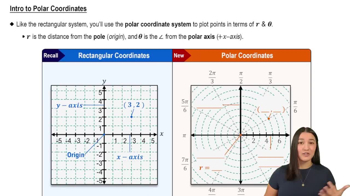
15–22. Sets in polar coordinates Sketch the following sets of points.
2 ≤ r ≤ 8
1
views

 Verified step by step guidance
 05:32
05:32
 06:29
06:29 06:21
06:2115–22. Sets in polar coordinates Sketch the following sets of points.
2 ≤ r ≤ 8
13–30. Graphing conic sections Determine whether the following equations describe a parabola, an ellipse, or a hyperbola, and then sketch a graph of the curve. For each parabola, specify the location of the focus and the equation of the directrix; for each ellipse, label the coordinates of the vertices and foci, and find the lengths of the major and minor axes; for each hyperbola, label the coordinates of the vertices and foci, and find the equations of the asymptotes.
4x = -y²
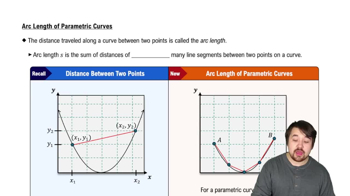
31–36. Eliminating the parameter Eliminate the parameter to express the following parametric equations as a single equation in x and y.
x=2 sin 8t, y=2 cos 8t
13–30. Graphing conic sections Determine whether the following equations describe a parabola, an ellipse, or a hyperbola, and then sketch a graph of the curve. For each parabola, specify the location of the focus and the equation of the directrix; for each ellipse, label the coordinates of the vertices and foci, and find the lengths of the major and minor axes; for each hyperbola, label the coordinates of the vertices and foci, and find the equations of the asymptotes.
x² = 12y
39–50. Equations of ellipses and hyperbolas Find an equation of the following ellipses and hyperbolas, assuming the center is at the origin.
An ellipse with vertices (±5, 0), passing through the point (4, 3/5)
15–30. Working with parametric equations Consider the following parametric equations.
a. Eliminate the parameter to obtain an equation in x and y.
b. Describe the curve and indicate the positive orientation.
x = cos t, y = sin² t; 0 ≤ t ≤ π