Ch.12 - Parametric and Polar Curves
Briggs - Calculus: Early Transcendentals 3rd Edition
Briggs3rd EditionCalculus: Early TranscendentalsISBN: 9780136847243Not the one you use?Change textbook
Chapter 12, Problem 12.1.31

31–36. Eliminating the parameter Eliminate the parameter to express the following parametric equations as a single equation in x and y.


x=2 sin 8t, y=2 cos 8t 

Verified step by step guidance
1
Start with the given parametric equations: \(x = 2 \sin(8t)\) and \(y = 2 \cos(8t)\).
Isolate the trigonometric functions by dividing both \(x\) and \(y\) by 2: \(\frac{x}{2} = \sin(8t)\) and \(\frac{y}{2} = \cos(8t)\).
Recall the Pythagorean identity for sine and cosine: \(\sin^2(\theta) + \cos^2(\theta) = 1\) for any angle \(\theta\).
Substitute \(\sin(8t)\) and \(\cos(8t)\) with \(\frac{x}{2}\) and \(\frac{y}{2}\) respectively in the identity: \(\left(\frac{x}{2}\right)^2 + \left(\frac{y}{2}\right)^2 = 1\).
Simplify the equation to get a single equation in terms of \(x\) and \(y\): \(\frac{x^2}{4} + \frac{y^2}{4} = 1\).

Verified video answer for a similar problem:

This video solution was recommended by our tutors as helpful for the problem above.
Video duration:
2m

Key Concepts

Here are the essential concepts you must grasp in order to answer the question correctly.

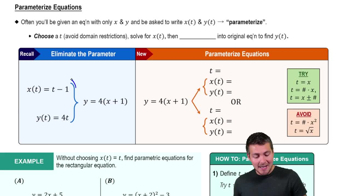
Parametric Equations

Parametric equations express the coordinates x and y as functions of a third variable, usually t, called the parameter. Understanding how x and y depend on t allows us to describe curves that may not be functions in the traditional sense.
Recommended video:
08:02
Parameterizing Equations

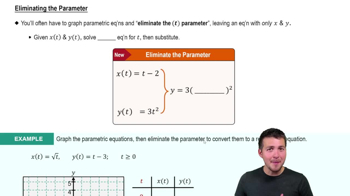
Eliminating the Parameter

Eliminating the parameter involves manipulating the parametric equations to remove the variable t, resulting in a single equation relating x and y. This often requires using trigonometric identities or algebraic techniques to combine the expressions.
Recommended video:
05:59
Eliminating the Parameter

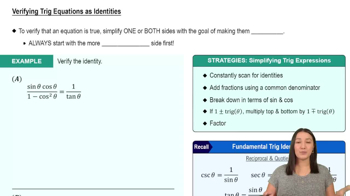
Trigonometric Identities

Trigonometric identities, such as sin²θ + cos²θ = 1, are essential tools for eliminating parameters when x and y are defined using sine and cosine functions. Applying these identities helps convert parametric forms into standard Cartesian equations.
Recommended video:
7:17
Verifying Trig Equations as Identities
Related Practice
Textbook Question

15–22. Sets in polar coordinates Sketch the following sets of points.


2 ≤ r ≤ 8

1
views

Textbook Question

13–30. Graphing conic sections Determine whether the following equations describe a parabola, an ellipse, or a hyperbola, and then sketch a graph of the curve. For each parabola, specify the location of the focus and the equation of the directrix; for each ellipse, label the coordinates of the vertices and foci, and find the lengths of the major and minor axes; for each hyperbola, label the coordinates of the vertices and foci, and find the equations of the asymptotes.


4x = -y²

1
views
Textbook Question

13–30. Graphing conic sections Determine whether the following equations describe a parabola, an ellipse, or a hyperbola, and then sketch a graph of the curve. For each parabola, specify the location of the focus and the equation of the directrix; for each ellipse, label the coordinates of the vertices and foci, and find the lengths of the major and minor axes; for each hyperbola, label the coordinates of the vertices and foci, and find the equations of the asymptotes.


x² = 12y

Textbook Question

39–50. Equations of ellipses and hyperbolas Find an equation of the following ellipses and hyperbolas, assuming the center is at the origin. 

An ellipse with vertices (±5, 0), passing through the point (4, 3/5)

Textbook Question

63–74. Arc length of polar curves Find the length of the following polar curves.


The complete circle r = a sin θ, where a > 0

Textbook Question

63–74. Arc length of polar curves Find the length of the following polar curves.


{Use of Tech} The complete limaçon r=4−2cosθ