
Textbook Question
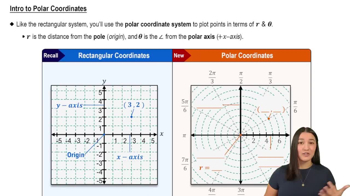
Tangent line at the origin Find the polar equation of the line tangent to the polar curve r=4cosθ at the origin. Explain why the slope of this line is undefined.

 Verified step by step guidance
 05:32
05:32 05:32
05:32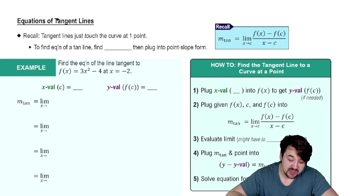 05:14
05:14Tangent line at the origin Find the polar equation of the line tangent to the polar curve r=4cosθ at the origin. Explain why the slope of this line is undefined.
39–50. Equations of ellipses and hyperbolas Find an equation of the following ellipses and hyperbolas, assuming the center is at the origin.
15–30. Working with parametric equations Consider the following parametric equations.
a. Eliminate the parameter to obtain an equation in x and y.
b. Describe the curve and indicate the positive orientation.
x = r − 1, y = r³; −4 ≤ r ≤ 4
Tangent lines for a hyperbola Find an equation of the line tangent to the hyperbola x²/a² + y²/b² = 1 at the point (x₀, y₀)
33–40. Areas of regions Make a sketch of the region and its bounding curves. Find the area of the region.
The region inside the curve r = √(cos θ)
15–30. Working with parametric equations Consider the following parametric equations.
a. Eliminate the parameter to obtain an equation in x and y.
b. Describe the curve and indicate the positive orientation.
x = 8 + 2t, y = 1; −∞ < t < ∞