
Textbook Question
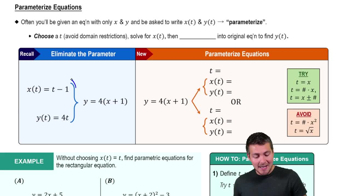
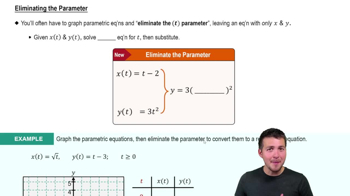
{Use of Tech} Implicit function graph Explain and carry out a method for graphing the curve x = 1 + cos² y − sin² y using parametric equations and a graphing utility.

 Verified step by step guidance
 08:02
08:02
 05:59
05:59 11:41
11:41{Use of Tech} Implicit function graph Explain and carry out a method for graphing the curve x = 1 + cos² y − sin² y using parametric equations and a graphing utility.
53–56. Circular motion Find parametric equations that describe the circular path of the following objects. For Exercises 53–55, assume (x, y) denotes the position of the object relative to the origin at the center of the circle. Use the units of time specified in the problem. There are many ways to describe any circle.
A bicyclist rides counterclockwise with constant speed around a circular velodrome track with a radius of 50 m, completing one lap in 24 seconds.
Express the polar equation r=f(θ) in parametric form in Cartesian coordinates, where θ is the parameter.
Tangent line at the origin Find the polar equation of the line tangent to the polar curve r=4cosθ at the origin. Explain why the slope of this line is undefined.
39–50. Equations of ellipses and hyperbolas Find an equation of the following ellipses and hyperbolas, assuming the center is at the origin.
What is the polar equation of the horizontal line y = 5?