
Ch.12 - Parametric and Polar Curves
Briggs - Calculus: Early Transcendentals 3rd Edition
Briggs3rd EditionCalculus: Early TranscendentalsISBN: 9780136847243Not the one you use?Change textbook
Chapter 12, Problem 12.3.22

Tangent line at the origin Find the polar equation of the line tangent to the polar curve r=4cosθ at the origin. Explain why the slope of this line is undefined.

Verified step by step guidance
1
Recall that the polar curve is given by \(r = 4 \cos \theta\). The point at the origin corresponds to \(r = 0\). Find the values of \(\theta\) where \(r = 0\) by solving \(4 \cos \theta = 0\).
Identify the points on the curve where it passes through the origin. These occur at the values of \(\theta\) found in the previous step. For each such \(\theta\), the curve passes through the origin \((r=0)\).
To find the slope of the tangent line in Cartesian coordinates, convert the polar coordinates to Cartesian using \(x = r \cos \theta\) and \(y = r \sin \theta\). Then express \(y\) as a function of \(x\) implicitly or find \(\frac{dy}{dx}\) using the chain rule and derivatives with respect to \(\theta\).
Use the formula for the slope of the tangent line to a polar curve: \(\frac{dy}{dx} = \frac{\frac{dr}{d\theta} \sin \theta + r \cos \theta}{\frac{dr}{d\theta} \cos \theta - r \sin \theta}\). Compute \(\frac{dr}{d\theta}\) and substitute \(r\), \(\theta\), and \(\frac{dr}{d\theta}\) at the point where \(r=0\).
Evaluate the slope at the origin. If the denominator of \(\frac{dy}{dx}\) is zero while the numerator is nonzero, the slope is undefined, indicating a vertical tangent line. This explains why the slope of the tangent line at the origin is undefined.

Verified video answer for a similar problem:

This video solution was recommended by our tutors as helpful for the problem above.
Video duration:
3m
Was this helpful?

Key Concepts

Here are the essential concepts you must grasp in order to answer the question correctly.

Polar Coordinates and Polar Curves

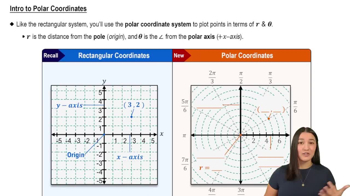
Polar coordinates represent points using a radius and an angle (r, θ) from the origin. Polar curves are equations relating r and θ, describing shapes in the plane. Understanding how to interpret and plot these curves is essential for analyzing their properties, such as tangents.
Recommended video:
05:32
Intro to Polar Coordinates

Tangent Lines in Polar Coordinates

The tangent line to a polar curve at a point can be found by converting the curve to Cartesian coordinates or by using the derivative dr/dθ. The slope of the tangent line is given by dy/dx, which can be expressed in terms of r, θ, and dr/dθ. This helps identify the direction and slope of the tangent line at specific points.
Recommended video:
05:32
Intro to Polar Coordinates

Undefined Slope and Vertical Tangents

A slope is undefined when the tangent line is vertical, meaning the change in x is zero while y changes. In polar curves, this occurs when the derivative dy/dx approaches infinity or is not defined. Recognizing when the slope is undefined explains the nature of the tangent line, especially at points like the origin.
Recommended video:
05:13
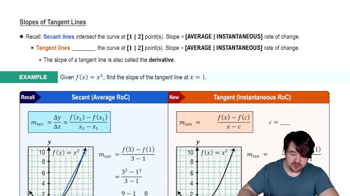
Slopes of Tangent Lines