
Ch.12 - Parametric and Polar Curves
Briggs - Calculus: Early Transcendentals 3rd Edition
Briggs3rd EditionCalculus: Early TranscendentalsISBN: 9780136847243Not the one you use?Change textbook
Chapter 12, Problem 12.3.1

Express the polar equation r=f(θ) in parametric form in Cartesian coordinates, where θ is the parameter.

Verified step by step guidance
1
Recall the relationship between polar and Cartesian coordinates: \(x = r \cos(\theta)\) and \(y = r \sin(\theta)\), where \(r\) is the radius and \(\theta\) is the angle parameter.
Given the polar equation \(r = f(\theta)\), substitute \(r\) into the Cartesian coordinate formulas to express \(x\) and \(y\) in terms of \(\theta\).
Write the parametric equations as \(x(\theta) = f(\theta) \cdot \cos(\theta)\) and \(y(\theta) = f(\theta) \cdot \sin(\theta)\).
Note that \(\theta\) serves as the parameter that varies, typically within an interval such as \([0, 2\pi]\), to trace the curve in the Cartesian plane.
Thus, the polar equation \(r = f(\theta)\) is expressed in parametric form as \(\left(x(\theta), y(\theta)\right) = \left(f(\theta) \cos(\theta), f(\theta) \sin(\theta)\right)\).

Verified video answer for a similar problem:

This video solution was recommended by our tutors as helpful for the problem above.
Video duration:
1m
Was this helpful?

Key Concepts

Here are the essential concepts you must grasp in order to answer the question correctly.

Polar Coordinates

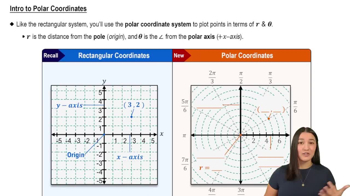
Polar coordinates represent points in a plane using a radius and an angle (r, θ) from the origin. The radius r is the distance from the origin, and θ is the angle measured from the positive x-axis. Understanding this system is essential to convert between polar and Cartesian forms.
Recommended video:
05:32
Intro to Polar Coordinates

Parametric Equations

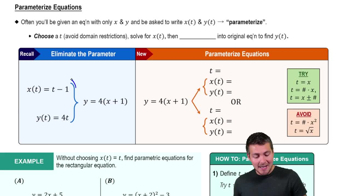
Parametric equations express coordinates as functions of a parameter, often denoted t or θ. Instead of y as a function of x, both x and y are defined separately in terms of the parameter, allowing more flexible representations of curves, including those defined in polar form.
Recommended video:
Guided course
08:02
Parameterizing Equations

Conversion from Polar to Cartesian Coordinates

To convert polar equations to Cartesian form, use the relationships x = r cos(θ) and y = r sin(θ). When r is given as a function of θ, substituting r = f(θ) into these formulas yields parametric equations x(θ) and y(θ) in Cartesian coordinates.
Recommended video:
05:32
Intro to Polar Coordinates
Related Practice
Textbook Question

13–30. Graphing conic sections Determine whether the following equations describe a parabola, an ellipse, or a hyperbola, and then sketch a graph of the curve. For each parabola, specify the location of the focus and the equation of the directrix; for each ellipse, label the coordinates of the vertices and foci, and find the lengths of the major and minor axes; for each hyperbola, label the coordinates of the vertices and foci, and find the equations of the asymptotes.


x²/9 + y²/4 = 1

Textbook Question

{Use of Tech} Implicit function graph Explain and carry out a method for graphing the curve x = 1 + cos² y − sin² y using parametric equations and a graphing utility.

Textbook Question

53–56. Circular motion Find parametric equations that describe the circular path of the following objects. For Exercises 53–55, assume (x, y) denotes the position of the object relative to the origin at the center of the circle. Use the units of time specified in the problem. There are many ways to describe any circle.


A bicyclist rides counterclockwise with constant speed around a circular velodrome track with a radius of 50 m, completing one lap in 24 seconds.

1
views
Textbook Question

Tangent line at the origin Find the polar equation of the line tangent to the polar curve r=4cosθ at the origin. Explain why the slope of this line is undefined.

Textbook Question

39–50. Equations of ellipses and hyperbolas Find an equation of the following ellipses and hyperbolas, assuming the center is at the origin. 

Textbook Question

15–30. Working with parametric equations Consider the following parametric equations.

a. Eliminate the parameter to obtain an equation in x and y.

b. Describe the curve and indicate the positive orientation.


x = 8 + 2t, y = 1; −∞ < t < ∞