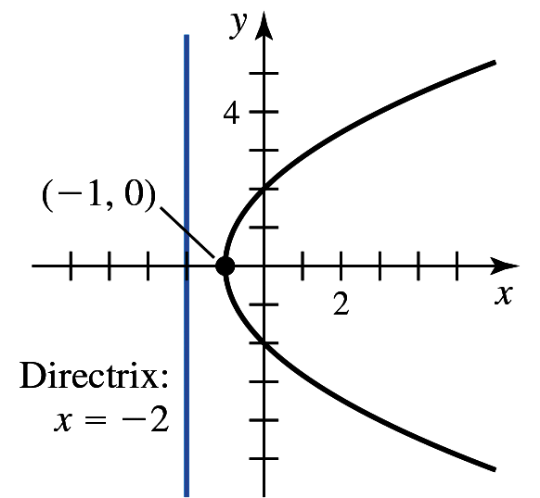
Back
Back
Problem 12.3.2
Explain why the slope of the line θ=π/2 is undefined.
Problem 12.2.79
Circles in general Show that the polar equation
r² - 2r r₀ cos(θ - θ₀) = R² - r₀²
describes a circle of radius R whose center has polar coordinates (r₀, θ₀)
Problem 12.2.46
37–48. Polar-to-Cartesian coordinates Convert the following equations to Cartesian coordinates. Describe the resulting curve.
r = sin θ sec² θ
Problem 12.4.92
90–94. Focal chords A focal chord of a conic section is a line through a focus joining two points of the curve. The latus rectum is the focal chord perpendicular to the major axis of the conic. Prove the following properties.
The length of the latus rectum of the parabola y ² =4px or x ² =4py is 4|p|.
Problem 12.4.37
31–38. Equations of parabolas Find an equation of the following parabolas. Unless otherwise specified, assume the vertex is at the origin.
Problem 12.4.91
90–94. Focal chords A focal chord of a conic section is a line through a focus joining two points of the curve. The latus rectum is the focal chord perpendicular to the major axis of the conic. Prove the following properties.
Let L be the latus rectum of the parabola y ² =4px for p>0. Let F be the focus of the parabola, P be any point on the parabola to the left of L, and D be the (shortest) distance between P and L. Show that for all P, D+|FP|+ is a constant. Find the constant.
Problem 12.4.58
57–62. Polar equations for conic sections Graph the following conic sections, labeling the vertices, foci, directrices, and asymptotes (if they exist). Use a graphing utility to check your work.
r = 3/(2 + cos θ)
Problem 12.2.8
Given three polar coordinate representations for the origin.
Problem 12.2.109
Subtle symmetry Without using a graphing utility, determine the symmetries (if any) of the curve r=4-sin (θ/2)
Problem 12.1.55
53–56. Circular motion Find parametric equations that describe the circular path of the following objects. For Exercises 53–55, assume (x, y) denotes the position of the object relative to the origin at the center of the circle. Use the units of time specified in the problem. There are many ways to describe any circle.
A bicyclist rides counterclockwise with constant speed around a circular velodrome track with a radius of 50 m, completing one lap in 24 seconds.
Problem 12.1.96
Multiple descriptions Which of the following parametric equations describe the same curve?
a. x = 2t², y = 4 + t; -4 ≤ t ≤ 4
b. x = 2t⁴, y = 4 + t²; -2 ≤ t ≤ 2
c. x = 2t^(2/3), y = 4 + t^(1/3); -64 ≤ t ≤ 64
Problem 12.1.78
77–80. Slopes of tangent lines Find all points at which the following curves have the given slope.
x = 2 cos t, y = 8 sin t; slope = -1
Problem 12.3.41
41–44. Intersection points and area Find all the intersection points of the following curves. Find the area of the entire region that lies within both curves
r = 3 sin θ and r = 3 cos θ
Problem 12.1.86
81–88. Arc length Find the arc length of the following curves on the given interval.
x = 2t sin t - t² cos t, y = 2t cos t + t² sin t; 0 ≤ t ≤ π
Problem 12.3.53
45–60. Areas of regions Find the area of the following regions.
The region common to the circles r = 2 sin θ and r = 1
Problem 12.4.12
How does the eccentricity determine the type of conic section?
Problem 12.2.50
49–52. Cartesian-to-polar coordinates Convert the following equations to polar coordinates.
y = 3
Problem 12.4.33
31–38. Equations of parabolas Find an equation of the following parabolas. Unless otherwise specified, assume the vertex is at the origin.
A parabola with focus at (3, 0)
Problem 12.1.82
81–88. Arc length Find the arc length of the following curves on the given interval.
x = 3 cos t, y = 3 sin t + 1; 0 ≤ t ≤ 2π
Problem 12.3.76
63–74. Arc length of polar curves Find the length of the following polar curves.
{Use of Tech} The complete limaçon r=4−2cosθ
Problem 12.4.22
13–30. Graphing conic sections Determine whether the following equations describe a parabola, an ellipse, or a hyperbola, and then sketch a graph of the curve. For each parabola, specify the location of the focus and the equation of the directrix; for each ellipse, label the coordinates of the vertices and foci, and find the lengths of the major and minor axes; for each hyperbola, label the coordinates of the vertices and foci, and find the equations of the asymptotes.
25y² - 4x² = 100
Problem 12.2.35
31–36. Converting coordinates Express the following Cartesian coordinates in polar coordinates in at least two different ways.
(-4, 4√3)
Problem 12.3.84
84. Arc length for polar curves: Prove that the length of the curve r = f(θ) for α ≤ θ ≤ β is
L = ∫(α to β) √(f(θ)² + f'(θ)²) dθ.
Problem 12.1.10
Use calculus to find the arc length of the line segment x=3t+1, y=4t, for 0≤t≤1. Check your work by finding the distance between the endpoints of the line segment.
Problem 12.2.102
102–104. Spirals Graph the following spirals. Indicate the direction in which the spiral is generated as θ increases, where θ>0. Let a=1 and a=−1.
Spiral of Archimedes: r = aθ
Problem 12.4.35
31–38. Equations of parabolas Find an equation of the following parabolas. Unless otherwise specified, assume the vertex is at the origin.
A parabola symmetric about the y-axis that passes through the point (2, -6)
Problem 12.4.52
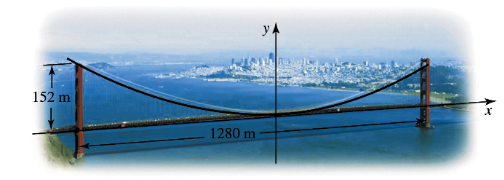
Golden Gate Bridge Completed in 1937, San Francisco’s Golden Gate Bridge is 2.7 km long and weighs about 890,000 tons. The length of the span between the two central towers is 1280 m; the towers themselves extend 152 m above the roadway. The cables that support the deck of the bridge between the two towers hang in a parabola (see figure). Assuming the origin is midway between the towers on the deck of the bridge, find an equation that describes the cables. How long is a guy wire that hangs vertically from the cables to the roadway 500 m from the center of the bridge?
Problem 12.4.16
13–30. Graphing conic sections Determine whether the following equations describe a parabola, an ellipse, or a hyperbola, and then sketch a graph of the curve. For each parabola, specify the location of the focus and the equation of the directrix; for each ellipse, label the coordinates of the vertices and foci, and find the lengths of the major and minor axes; for each hyperbola, label the coordinates of the vertices and foci, and find the equations of the asymptotes.
x²/9 + y²/4 = 1
Problem 12.1.25
15–30. Working with parametric equations Consider the following parametric equations.
a. Eliminate the parameter to obtain an equation in x and y.
b. Describe the curve and indicate the positive orientation.
x = r − 1, y = r³; −4 ≤ r ≤ 4
Problem 12.4.43
39–50. Equations of ellipses and hyperbolas Find an equation of the following ellipses and hyperbolas, assuming the center is at the origin.
An ellipse with vertices (±5, 0), passing through the point (4, 3/5)