Ch.12 - Parametric and Polar Curves
Briggs - Calculus: Early Transcendentals 3rd Edition
Briggs3rd EditionCalculus: Early TranscendentalsISBN: 9780136847243Not the one you use?Change textbook
Chapter 12, Problem 12.2.50

49–52. Cartesian-to-polar coordinates Convert the following equations to polar coordinates.


y = 3

Verified step by step guidance
1
Recall the relationships between Cartesian coordinates \((x, y)\) and polar coordinates \((r, \theta)\): \(x = r \cos{\theta}\) and \(y = r \sin{\theta}\).
Given the equation \(y = 3\), substitute \(y\) with its polar form: \(r \sin{\theta} = 3\).
Isolate \(r\) to express it in terms of \(\theta\): \(r = \frac{3}{\sin{\theta}}\).
Note the domain restrictions where \(\sin{\theta} \neq 0\) to avoid division by zero.
The polar form of the equation \(y = 3\) is therefore \(r = \frac{3}{\sin{\theta}}\).

Verified video answer for a similar problem:

This video solution was recommended by our tutors as helpful for the problem above.
Video duration:
1m
Was this helpful?

Key Concepts

Here are the essential concepts you must grasp in order to answer the question correctly.

Polar Coordinates System

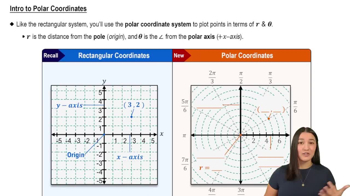
Polar coordinates represent points in the plane using a radius and an angle, denoted as (r, θ), where r is the distance from the origin and θ is the angle measured from the positive x-axis. This system is useful for describing curves that are difficult to express in Cartesian coordinates.
Recommended video:
05:32
Intro to Polar Coordinates

Conversion Formulas Between Cartesian and Polar Coordinates

To convert from Cartesian (x, y) to polar (r, θ), use r = √(x² + y²) and θ = arctan(y/x). Conversely, x = r cos(θ) and y = r sin(θ). These formulas allow rewriting equations from one coordinate system to the other.
Recommended video:
05:32
Intro to Polar Coordinates

Expressing Cartesian Equations in Polar Form

To convert a Cartesian equation like y = 3 into polar form, substitute y with r sin(θ). This transforms the equation into r sin(θ) = 3, which can then be analyzed or manipulated using polar coordinates.
Recommended video:
3:47
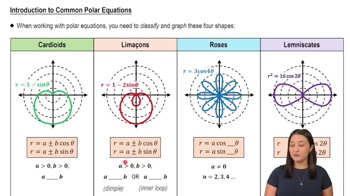
Introduction to Common Polar Equations
Related Practice
Textbook Question

31–36. Converting coordinates Express the following Cartesian coordinates in polar coordinates in at least two different ways.


(-4, 4√3)

1
views

Textbook Question

Subtle symmetry Without using a graphing utility, determine the symmetries (if any) of the curve r=4-sin (θ/2)

Textbook Question

81–88. Arc length Find the arc length of the following curves on the given interval.


x = 3 cos t, y = 3 sin t + 1; 0 ≤ t ≤ 2π

Textbook Question

93–94. Parametric equations of ellipses Find parametric equations (not unique) of the following ellipses (see Exercises 91–92). Graph the ellipse and find a description in terms of x and y.


An ellipse centered at (-2, -3) with major and minor axes of lengths 30 and 20, parallel to the x- and y-axes, respectively, generated counterclockwise (Hint: Shift the parametric equations.)

1
views
Textbook Question

37–48. Polar-to-Cartesian coordinates Convert the following equations to Cartesian coordinates. Describe the resulting curve.


r = 6 cos θ + 8 sin θ

Textbook Question

13–30. Graphing conic sections Determine whether the following equations describe a parabola, an ellipse, or a hyperbola, and then sketch a graph of the curve. For each parabola, specify the location of the focus and the equation of the directrix; for each ellipse, label the coordinates of the vertices and foci, and find the lengths of the major and minor axes; for each hyperbola, label the coordinates of the vertices and foci, and find the equations of the asymptotes.


x² + y²/9 = 1