
Textbook Question
31–36. Converting coordinates Express the following Cartesian coordinates in polar coordinates in at least two different ways.
(-4, 4√3)
1
views

 Verified step by step guidance
 08:02
08:02
 06:29
06:29 6:04
6:0431–36. Converting coordinates Express the following Cartesian coordinates in polar coordinates in at least two different ways.
(-4, 4√3)
49–52. Cartesian-to-polar coordinates Convert the following equations to polar coordinates.
y = 3
13–30. Graphing conic sections Determine whether the following equations describe a parabola, an ellipse, or a hyperbola, and then sketch a graph of the curve. For each parabola, specify the location of the focus and the equation of the directrix; for each ellipse, label the coordinates of the vertices and foci, and find the lengths of the major and minor axes; for each hyperbola, label the coordinates of the vertices and foci, and find the equations of the asymptotes.
4x² - y² = 16
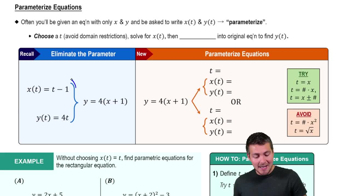
37–52. Curves to parametric equations Find parametric equations for the following curves. Include an interval for the parameter values. Answers are not unique.
The line that passes through the points P(1, 1) and Q(3, 5), oriented in the direction of increasing x
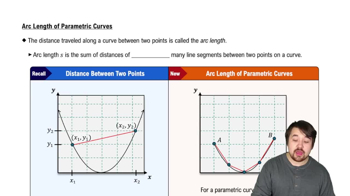
81–88. Arc length Find the arc length of the following curves on the given interval.
x = eᵗ sin t, y = eᵗ cos t; 0 ≤ t ≤ 2π
37–48. Polar-to-Cartesian coordinates Convert the following equations to Cartesian coordinates. Describe the resulting curve.
r = 6 cos θ + 8 sin θ