Ch.12 - Parametric and Polar Curves
Briggs - Calculus: Early Transcendentals 3rd Edition
Briggs3rd EditionCalculus: Early TranscendentalsISBN: 9780136847243Not the one you use?Change textbook
Chapter 12, Problem 12.2.35

31–36. Converting coordinates Express the following Cartesian coordinates in polar coordinates in at least two different ways.


(-4, 4√3)

Verified step by step guidance
1
Recall the formulas to convert Cartesian coordinates \((x, y)\) to polar coordinates \((r, \theta)\): \(r = \sqrt{x^2 + y^2}\) and \(\theta = \arctan\left(\frac{y}{x}\right)\), but be careful with the quadrant of the point when determining \(\theta\).
Calculate the radius \(r\) using the given coordinates \(x = -4\) and \(y = 4\sqrt{3}\): \(r = \sqrt{(-4)^2 + (4\sqrt{3})^2}\).
Find the angle \(\theta\) by computing \(\arctan\left(\frac{y}{x}\right) = \arctan\left(\frac{4\sqrt{3}}{-4}\right)\), then adjust \(\theta\) to the correct quadrant since \(x\) is negative and \(y\) is positive (which places the point in the second quadrant).
Express the polar coordinates as \((r, \theta)\) where \(r\) is the radius found in step 2 and \(\theta\) is the angle found in step 3, typically in radians.
For the second method, use the fact that \(\theta\) can also be expressed as \(\pi - |\arctan(\frac{y}{|x|})|\) to directly find the angle in the second quadrant, then write the polar coordinates again as \((r, \theta)\).

Verified video answer for a similar problem:

This video solution was recommended by our tutors as helpful for the problem above.
Video duration:
3m
Was this helpful?

Key Concepts

Here are the essential concepts you must grasp in order to answer the question correctly.

Cartesian and Polar Coordinate Systems

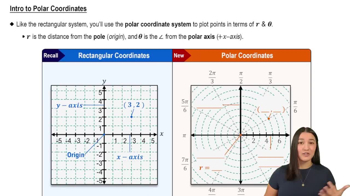
Cartesian coordinates represent points using (x, y) values on perpendicular axes, while polar coordinates describe points by a distance from the origin (r) and an angle (θ) from the positive x-axis. Understanding both systems is essential for converting between them.
Recommended video:
05:32
Intro to Polar Coordinates

Conversion Formulas Between Cartesian and Polar Coordinates

To convert from Cartesian (x, y) to polar (r, θ), use r = √(x² + y²) to find the radius and θ = arctan(y/x) to find the angle. Adjustments to θ may be needed depending on the quadrant where the point lies.
Recommended video:
05:32
Intro to Polar Coordinates

Multiple Representations of Polar Coordinates

Polar coordinates are not unique; the same point can be represented by different pairs (r, θ) by adding or subtracting full rotations (2π) to the angle or by using negative radius values with adjusted angles. Recognizing these variations helps express coordinates in multiple valid ways.
Recommended video:
05:32
Intro to Polar Coordinates