
Textbook Question
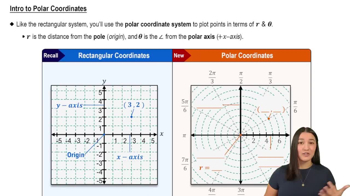
31–36. Converting coordinates Express the following Cartesian coordinates in polar coordinates in at least two different ways.
(-4, 4√3)
1
views

 Verified step by step guidance
 05:32
05:32 05:32
05:32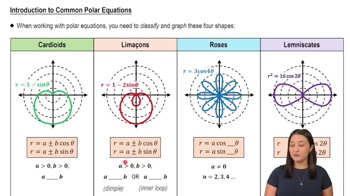 3:47
3:4731–36. Converting coordinates Express the following Cartesian coordinates in polar coordinates in at least two different ways.
(-4, 4√3)
Subtle symmetry Without using a graphing utility, determine the symmetries (if any) of the curve r=4-sin (θ/2)
81–88. Arc length Find the arc length of the following curves on the given interval.
x = 3 cos t, y = 3 sin t + 1; 0 ≤ t ≤ 2π
93–94. Parametric equations of ellipses Find parametric equations (not unique) of the following ellipses (see Exercises 91–92). Graph the ellipse and find a description in terms of x and y.
An ellipse centered at (-2, -3) with major and minor axes of lengths 30 and 20, parallel to the x- and y-axes, respectively, generated counterclockwise (Hint: Shift the parametric equations.)
37–48. Polar-to-Cartesian coordinates Convert the following equations to Cartesian coordinates. Describe the resulting curve.
r = 6 cos θ + 8 sin θ
13–30. Graphing conic sections Determine whether the following equations describe a parabola, an ellipse, or a hyperbola, and then sketch a graph of the curve. For each parabola, specify the location of the focus and the equation of the directrix; for each ellipse, label the coordinates of the vertices and foci, and find the lengths of the major and minor axes; for each hyperbola, label the coordinates of the vertices and foci, and find the equations of the asymptotes.
x² + y²/9 = 1