Ch.12 - Parametric and Polar Curves
Briggs - Calculus: Early Transcendentals 3rd Edition
Briggs3rd EditionCalculus: Early TranscendentalsISBN: 9780136847243Not the one you use?Change textbook
Chapter 12, Problem 12.1.94

93–94. Parametric equations of ellipses Find parametric equations (not unique) of the following ellipses (see Exercises 91–92). Graph the ellipse and find a description in terms of x and y.


An ellipse centered at (-2, -3) with major and minor axes of lengths 30 and 20, parallel to the x- and y-axes, respectively, generated counterclockwise (Hint: Shift the parametric equations.)

Verified step by step guidance
1
Identify the center of the ellipse as \((-2, -3)\), the lengths of the major and minor axes as 30 and 20, respectively, and note that the axes are parallel to the x- and y-axes.
Recall the standard parametric equations for an ellipse centered at the origin with semi-major axis \(a\) and semi-minor axis \(b\): \[x = a \cos(t), \quad y = b \sin(t)\] where \(t\) is the parameter varying from \(0\) to \(2\pi\).
Calculate the semi-major axis \(a\) and semi-minor axis \(b\) by dividing the lengths of the axes by 2: \[a = \frac{30}{2} = 15, \quad b = \frac{20}{2} = 10\]
Shift the parametric equations to account for the center \((-2, -3)\) by adding the center coordinates to the \(x\) and \(y\) components: \[x = -2 + 15 \cos(t), \quad y = -3 + 10 \sin(t)\]
Write the equation of the ellipse in terms of \(x\) and \(y\) by using the standard form centered at \((-2, -3)\): \[\frac{(x + 2)^2}{15^2} + \frac{(y + 3)^2}{10^2} = 1\]

Verified video answer for a similar problem:

This video solution was recommended by our tutors as helpful for the problem above.
Video duration:
2m
Was this helpful?

Key Concepts

Here are the essential concepts you must grasp in order to answer the question correctly.

Parametric Equations of an Ellipse

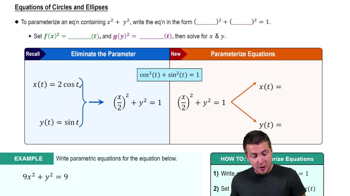
Parametric equations express the coordinates of points on an ellipse as functions of a parameter, usually t. For an ellipse centered at the origin with axes aligned to the coordinate axes, the standard form is x = a cos(t), y = b sin(t), where a and b are the semi-major and semi-minor axes. These equations trace the ellipse as t varies from 0 to 2π.
Recommended video:
Guided course
06:03
Parameterizing Equations of Circles & Ellipses

Shifting the Center of an Ellipse

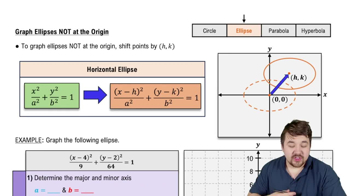
When an ellipse is not centered at the origin, its parametric equations must be adjusted by adding the center coordinates to the standard form. If the center is at (h, k), the equations become x = h + a cos(t) and y = k + b sin(t). This shift translates the ellipse without changing its shape or orientation.
Recommended video:
4:50
Graph Ellipses NOT at Origin

Relationship Between Parametric and Cartesian Forms

The Cartesian equation of an ellipse relates x and y directly, typically in the form ((x - h)^2)/a^2 + ((y - k)^2)/b^2 = 1. Parametric equations provide a way to generate points on the ellipse, while the Cartesian form describes all points satisfying the ellipse's geometric definition. Understanding both forms helps in graphing and analyzing ellipses.
Recommended video:
Guided course
06:03
Parameterizing Equations of Circles & Ellipses