Back
Back
Problem 12.1.105
Find the area of the region bounded by the astroid x = cos³ t, y = sin³ t, for 0 ≤ t ≤ 2π
Problem 12.1.51
37–52. Curves to parametric equations Find parametric equations for the following curves. Include an interval for the parameter values. Answers are not unique.
The upper half of the parabola x=y ², originating at (0, 0)
Problem 12.4.45
39–50. Equations of ellipses and hyperbolas Find an equation of the following ellipses and hyperbolas, assuming the center is at the origin.
A hyperbola with vertices (±2, 0) and asymptotes y = ±3x/2
Problem 12.4.31
31–38. Equations of parabolas Find an equation of the following parabolas. Unless otherwise specified, assume the vertex is at the origin.
A parabola that opens to the right with directrix x = -4
Problem 12.3.22
Tangent line at the origin Find the polar equation of the line tangent to the polar curve r=4cosθ at the origin. Explain why the slope of this line is undefined.
Problem 12.4.21
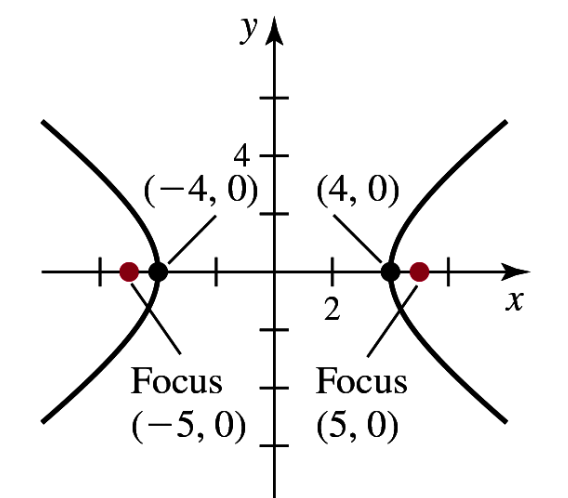
13–30. Graphing conic sections Determine whether the following equations describe a parabola, an ellipse, or a hyperbola, and then sketch a graph of the curve. For each parabola, specify the location of the focus and the equation of the directrix; for each ellipse, label the coordinates of the vertices and foci, and find the lengths of the major and minor axes; for each hyperbola, label the coordinates of the vertices and foci, and find the equations of the asymptotes.
4x² - y² = 16
Problem 12.4.69
69–72. Tangent lines Find an equation of the line tangent to the following curves at the given point.
x² = -6y; (-6, -6)
Problem 12.2.4
What is the polar equation of a circle of radius √(a²+b²) centered at (a, b)?
Problem 12.2.49
49–52. Cartesian-to-polar coordinates Convert the following equations to polar coordinates.
y = x²
Problem 12.3.43
41–44. Intersection points and area Find all the intersection points of the following curves. Find the area of the entire region that lies within both curves
r = 1 + sin θ and r = 1 + cos θ
Problem 12.1.17
15–30. Working with parametric equations Consider the following parametric equations.
a. Eliminate the parameter to obtain an equation in x and y.
b. Describe the curve and indicate the positive orientation.
x = √t + 4, y = 3√t; 0 ≤ t ≤ 16
Problem 12.4.49
39–50. Equations of ellipses and hyperbolas Find an equation of the following ellipses and hyperbolas, assuming the center is at the origin.
Problem 12.2.56
53–56. Simple curves Tabulate and plot enough points to sketch a graph of the following equations.
r = 1 - cos θ
Problem 12.4.35
31–38. Equations of parabolas Find an equation of the following parabolas. Unless otherwise specified, assume the vertex is at the origin.
A parabola symmetric about the y-axis that passes through the point (2, -6)
Problem 12.1.43
37–52. Curves to parametric equations Find parametric equations for the following curves. Include an interval for the parameter values. Answers are not unique.
The segment of the parabola y=2x ²−4, where −1≤x≤5
Problem 12.2.26
25–30. Converting coordinates Express the following polar coordinates in Cartesian coordinates.
(1, 2π/3)
Problem 12.2.16
15–22. Sets in polar coordinates Sketch the following sets of points.
r = 3
Problem 12.3.84
84. Arc length for polar curves: Prove that the length of the curve r = f(θ) for α ≤ θ ≤ β is
L = ∫(α to β) √(f(θ)² + f'(θ)²) dθ.
Problem 12.2.82
80–83. Equations of circles Use the results of Exercises 78–79 to describe and graph the following circles.
r² - 8r cos(θ - π/2) = 9
Problem 12.1.77
77–80. Slopes of tangent lines Find all points at which the following curves have the given slope.
x = 4 cos t, y = 4 sin t; slope = 1/2
Problem 12.2.6
What is the polar equation of the horizontal line y = 5?
Problem 12.2.2
Write the equations that are used to express a point with polar coordinates (r, θ) in Cartesian coordinates.
Problem 12.2.111
Cartesian lemniscate Find the equation in Cartesian coordinates of the lemniscate r² = a² cos 2θ, where a is a real number.
Problem 12.3.20
11–20. Slopes of tangent lines Find the slope of the line tangent to the following polar curves at the given points.
r = 2θ; (π/2, π/4)
Problem 12.3.51
45–60. Areas of regions Find the area of the following regions.
The region inside the rose r = 4 sin 2θ and inside the circle r = 2
Problem 12.1.94
93–94. Parametric equations of ellipses Find parametric equations (not unique) of the following ellipses (see Exercises 91–92). Graph the ellipse and find a description in terms of x and y.
An ellipse centered at (-2, -3) with major and minor axes of lengths 30 and 20, parallel to the x- and y-axes, respectively, generated counterclockwise (Hint: Shift the parametric equations.)
Problem 12.2.5
What is the polar equation of the vertical line x = 5?
Problem 12.1.10
Use calculus to find the arc length of the line segment x=3t+1, y=4t, for 0≤t≤1. Check your work by finding the distance between the endpoints of the line segment.
Problem 12.1.25
15–30. Working with parametric equations Consider the following parametric equations.
a. Eliminate the parameter to obtain an equation in x and y.
b. Describe the curve and indicate the positive orientation.
x = r − 1, y = r³; −4 ≤ r ≤ 4
Problem 12.4.43
39–50. Equations of ellipses and hyperbolas Find an equation of the following ellipses and hyperbolas, assuming the center is at the origin.
An ellipse with vertices (±5, 0), passing through the point (4, 3/5)