Back
Back
Problem 12.4.43
39–50. Equations of ellipses and hyperbolas Find an equation of the following ellipses and hyperbolas, assuming the center is at the origin.
An ellipse with vertices (±5, 0), passing through the point (4, 3/5)
Problem 12.1.52
37–52. Curves to parametric equations Find parametric equations for the following curves. Include an interval for the parameter values. Answers are not unique.
The lower half of the circle centered at (−2, 2) with radius 6, oriented in the counterclockwise direction
Problem 12.1.64
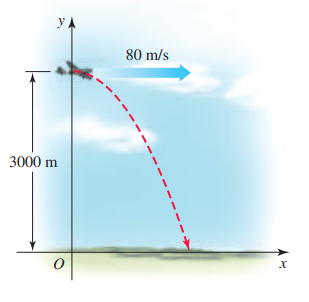
Air drop A plane traveling horizontally at 80 m/s over flat ground at an elevation of 3000 m releases an emergency packet. The trajectory of the packet is given by
x = 80t, y = −4.9t² + 3000, t ≥ 0
where the origin is the point on the ground directly beneath the plane at the moment of the release (see figure). Graph the trajectory of the packet and find the coordinates of the point where the packet lands.
Problem 12.3.41
41–44. Intersection points and area Find all the intersection points of the following curves. Find the area of the entire region that lies within both curves
r = 3 sin θ and r = 3 cos θ
Problem 12.4.65
63–66. Tracing hyperbolas and parabolas Graph the following equations. Then use arrows and labeled points to indicate how the curve is generated as θ increases from 0 to 2π.
r = 3/(1 - cos θ)
Problem 12.4.69
69–72. Tangent lines Find an equation of the line tangent to the following curves at the given point.
x² = -6y; (-6, -6)
Problem 12.3.45
45–60. Areas of regions Find the area of the following regions.
The region outside the circle r = 1/2 and inside the circle r = cos θ
Problem 12.3.55
45–60. Areas of regions Find the area of the following regions.
The region inside the outer loop but outside the inner loop of the limaçon r = 3 - 6 sin θ
Problem 12.2.79
Circles in general Show that the polar equation
r² - 2r r₀ cos(θ - θ₀) = R² - r₀²
describes a circle of radius R whose center has polar coordinates (r₀, θ₀)
Problem 12.1.75
73–76. Tangent lines Find an equation of the line tangent to the curve at the point corresponding to the given value of t.
x=cos t+t sin t,y=sin t−t cos t; t=π/4
Problem 12.1.49
37–52. Curves to parametric equations Find parametric equations for the following curves. Include an interval for the parameter values. Answers are not unique.
The line that passes through the points P(1, 1) and Q(3, 5), oriented in the direction of increasing x
Problem 12.2.52
49–52. Cartesian-to-polar coordinates Convert the following equations to polar coordinates.
(x - 1)² + y² = 1
Problem 12.3.73
63–74. Arc length of polar curves Find the length of the following polar curves.
{Use of Tech} The complete limaçon r=4−2cosθ
Problem 12.1.43
37–52. Curves to parametric equations Find parametric equations for the following curves. Include an interval for the parameter values. Answers are not unique.
The segment of the parabola y=2x ²−4, where −1≤x≤5
Problem 12.1.25
15–30. Working with parametric equations Consider the following parametric equations.
a. Eliminate the parameter to obtain an equation in x and y.
b. Describe the curve and indicate the positive orientation.
x = r − 1, y = r³; −4 ≤ r ≤ 4
Problem 12.1.7
Find the slope of the parametric curve x=−2t ³ +1, y=3t ², for −∞<t<∞, at the point corresponding to t=2.
Problem 12.R.38
Cartesian conversion Write the equation x=y ² in polar coordinates and state values of θ that produce the entire graph of the parabola.
Problem 12.R.8a
7–8. Parametric curves and tangent lines
a. Eliminate the parameter to obtain an equation in x and y.
x = 4sin 2t, y = 3cos 2t, for 0 ≤ t ≤ π; t = π/6
Problem R.12.14
14–18. Parametric descriptions Write parametric equations for the following curves. Solutions are not unique.
The segment of the curve x=y ³ +y+1 that starts at (1, 0) and ends at (11, 2).
Problem 12.R.2
Eliminate the parameter in the parametric equations x=1+sin t, y=3+2 sin t, for 0≤t≤π/2, and describe the curve, indicating its positive orientation. How does this curve differ from the curve x=1+sin t, y=3+2 sin t, for π/2≤t≤π?
Problem 12.R.76
General equations for a circle Prove that the equations
X = a cos t + b sin t, y = c cos t + d sin t
where a, b, c, and d are real numbers, describe a circle of radius R provided a² +c² =b² +d² = R² and ab+cd=0.
Problem 12.R.40b
40–41. {Use of Tech} Slopes of tangent lines
b. Find the slope of the lines tangent to the curve at the origin (when relevant).
r =3 − 6 cos θ
Problem 12.R.49
44–49. Areas of regions Find the area of the following regions.
The region inside the cardioid r=1+cosθ and outside the cardioid r=1−cosθ
Problem 12.R.11a
10–12. Parametric curves
a. Eliminate the parameter to obtain an equation in x and y.
x = 3cos(-t), y = 3sin(-t) - 1, for 0 ≤ t ≤ π; (0, -4)
Problem 12.R.4
3–6. Eliminating the parameter Eliminate the parameter to find a description of the following curves in terms of x and y. Give a geometric description and the positive orientation of the curve.
x = sin t - 3, y = cos t + 6; 0 ≤ t ≤ π
Problem 12.R.62
61–64. Polar equations for conic sections Graph the following conic sections, labeling vertices, foci, directrices, and asymptotes (if they exist). Give the eccentricity of the curve. Use a graphing utility to check your work.
r = 3/(1 - 2 cos θ)
Problem 12.R.20
19–20. Area bounded by parametric curves Find the area of the following regions. (Hint: See Exercises 103–105 in Section 12.1.) The region bounded by the y-axis and the parametric curve
The region bounded by the x-axis and the parametric curve x=cost, y=sin2t, for 0≤t≤π/2
Problem 12.R.65
65–68. Eccentricity-directrix approach Find an equation of the following curves, assuming the center is at the origin. Graph the curve, labeling vertices, foci, asymptotes (if they exist), and directrices.
A hyperbola with vertices (0, ±2) and directrices y = ±1
Problem 12.R.68
65–68. Eccentricity-directrix approach Find an equation of the following curves, assuming the center is at the origin. Graph the curve, labeling vertices, foci, asymptotes (if they exist), and directrices.
A hyperbola with vertices (±4, 0) and directrices x = ±2
Problem 12.R.12a
10–12. Parametric curves
a. Eliminate the parameter to obtain an equation in x and y.
x = ln t, y = 8ln t², for 1 ≤ t ≤ e²; (1, 16)