
Textbook Question
Find the area of the region bounded by the astroid x = cos³ t, y = sin³ t, for 0 ≤ t ≤ 2π

 Verified step by step guidance
 5:33
5:33
 07:39
07:39 6:22
6:22Find the area of the region bounded by the astroid x = cos³ t, y = sin³ t, for 0 ≤ t ≤ 2π
11–20. Slopes of tangent lines Find the slope of the line tangent to the following polar curves at the given points.
r = 4 cos 2θ; at the tips of the leaves
Without calculating derivatives, determine the slopes of each of the lines tangent to the curve r=8 cos θ−4 at the origin.
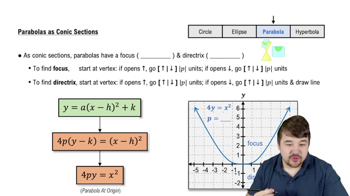
57–62. Polar equations for conic sections Graph the following conic sections, labeling the vertices, foci, directrices, and asymptotes (if they exist). Use a graphing utility to check your work.
r = 1/(2 - 2 sin θ)
90–94. Focal chords A focal chord of a conic section is a line through a focus joining two points of the curve. The latus rectum is the focal chord perpendicular to the major axis of the conic. Prove the following properties.
Let L be the latus rectum of the parabola y ² =4px for p>0. Let F be the focus of the parabola, P be any point on the parabola to the left of L, and D be the (shortest) distance between P and L. Show that for all P, D+|FP|+ is a constant. Find the constant.
90–94. Focal chords A focal chord of a conic section is a line through a focus joining two points of the curve. The latus rectum is the focal chord perpendicular to the major axis of the conic. Prove the following properties.
The length of the latus rectum of the parabola y ² =4px or x ² =4py is 4|p|.