Ch.12 - Parametric and Polar Curves
Briggs - Calculus: Early Transcendentals 3rd Edition
Briggs3rd EditionCalculus: Early TranscendentalsISBN: 9780136847243Not the one you use?Change textbook
Chapter 12, Problem 12.1.105

Find the area of the region bounded by the astroid x = cos³ t, y = sin³ t, for 0 ≤ t ≤ 2π

Verified step by step guidance
1
Recognize that the given parametric equations describe an astroid: \(x = \cos^{3} t\) and \(y = \sin^{3} t\) for \(0 \leq t \leq 2\pi\). The curve is closed and symmetric.
Recall that the area enclosed by a parametric curve \(x = x(t)\), \(y = y(t)\) for \(t\) in \([a,b]\) can be found using the formula: \(A = \int_{a}^{b} y(t) \frac{dx}{dt} \, dt\).
Compute the derivative \(\frac{dx}{dt}\): since \(x = \cos^{3} t\), use the chain rule to find \(\frac{dx}{dt} = 3 \cos^{2} t (-\sin t) = -3 \cos^{2} t \sin t\).
Set up the integral for the area: \(A = \int_{0}^{2\pi} \sin^{3} t \cdot (-3 \cos^{2} t \sin t) \, dt = -3 \int_{0}^{2\pi} \sin^{4} t \cos^{2} t \, dt\).
Use symmetry properties or trigonometric identities to simplify the integral before evaluating. For example, consider the periodicity and positivity of the integrand over \([0, 2\pi]\) or reduce the integral to a simpler form using power-reduction formulas.

Verified video answer for a similar problem:

This video solution was recommended by our tutors as helpful for the problem above.
Video duration:
4m
Was this helpful?

Key Concepts

Here are the essential concepts you must grasp in order to answer the question correctly.

Parametric Equations

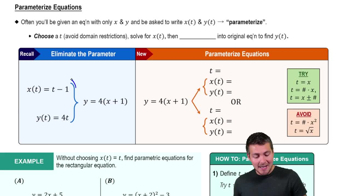
Parametric equations express the coordinates of points on a curve as functions of a parameter, often denoted t. In this problem, x and y are given in terms of t, allowing the curve to be traced as t varies from 0 to 2π. Understanding how to work with parametric forms is essential for analyzing and integrating along such curves.
Recommended video:
Guided course
08:02
Parameterizing Equations

Area Enclosed by a Parametric Curve

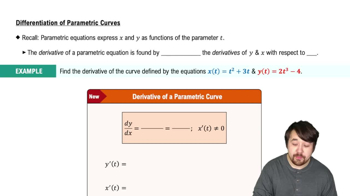
The area enclosed by a parametric curve defined by x(t) and y(t) over an interval [a, b] can be found using the integral formula A = ∫ y(t) x'(t) dt. This method converts the problem of finding area into evaluating an integral involving the derivatives of the parametric functions, which is crucial for solving the given problem.
Recommended video:
06:49
Differentiation of Parametric Curves

Properties of the Astroid Curve

An astroid is a specific type of hypocycloid with four cusps, often defined by x = cos³ t and y = sin³ t. Knowing its geometric properties, such as symmetry and periodicity, helps simplify calculations and understand the shape of the region whose area is to be found.
Recommended video:
06:21
Properties of Functions
Related Practice
Textbook Question

57–62. Polar equations for conic sections Graph the following conic sections, labeling the vertices, foci, directrices, and asymptotes (if they exist). Use a graphing utility to check your work.


r = 3/(2 + cos θ)

Textbook Question

11–20. Slopes of tangent lines Find the slope of the line tangent to the following polar curves at the given points.


r = 4 cos 2θ; at the tips of the leaves

Textbook Question

Without calculating derivatives, determine the slopes of each of the lines tangent to the curve r=8 cos θ−4 at the origin.

Textbook Question

13–30. Graphing conic sections Determine whether the following equations describe a parabola, an ellipse, or a hyperbola, and then sketch a graph of the curve. For each parabola, specify the location of the focus and the equation of the directrix; for each ellipse, label the coordinates of the vertices and foci, and find the lengths of the major and minor axes; for each hyperbola, label the coordinates of the vertices and foci, and find the equations of the asymptotes.


x²/9 + y²/4 = 1

Textbook Question

57–62. Polar equations for conic sections Graph the following conic sections, labeling the vertices, foci, directrices, and asymptotes (if they exist). Use a graphing utility to check your work.


r = 1/(2 - 2 sin θ)

Textbook Question

90–94. Focal chords A focal chord of a conic section is a line through a focus joining two points of the curve. The latus rectum is the focal chord perpendicular to the major axis of the conic. Prove the following properties.

Let L be the latus rectum of the parabola y ² =4px for p>0. Let F be the focus of the parabola, P be any point on the parabola to the left of L, and D be the (shortest) distance between P and L. Show that for all P, D+|FP|+ is a constant. Find the constant.