Ch.12 - Parametric and Polar Curves
Briggs - Calculus: Early Transcendentals 3rd Edition
Briggs3rd EditionCalculus: Early TranscendentalsISBN: 9780136847243Not the one you use?Change textbook
Chapter 12, Problem 12.1.114

Second derivative Assume a curve is given by the parametric equations x=f(t) and y=g(t), where f and g are twice differentiable. Use the Chain Rule to show that y″x=(fʹ(t)g″(t)−gʹ(t)f″(t))/(fʹ(t))³.  

Verified step by step guidance
1
Recall that for parametric equations \(x = f(t)\) and \(y = g(t)\), the first derivative of \(y\) with respect to \(x\) is given by the chain rule as \(\frac{dy}{dx} = \frac{\frac{dy}{dt}}{\frac{dx}{dt}} = \frac{g'(t)}{f'(t)}\).
To find the second derivative \(\frac{d^2y}{dx^2}\), we differentiate \(\frac{dy}{dx}\) with respect to \(x\). Using the chain rule, this is \(\frac{d}{dx} \left( \frac{dy}{dx} \right) = \frac{d}{dt} \left( \frac{g'(t)}{f'(t)} \right) \cdot \frac{dt}{dx}\).
Calculate \(\frac{d}{dt} \left( \frac{g'(t)}{f'(t)} \right)\) using the quotient rule: \(\frac{d}{dt} \left( \frac{g'(t)}{f'(t)} \right) = \frac{g''(t) f'(t) - g'(t) f''(t)}{(f'(t))^2}\).
Since \(\frac{dt}{dx} = \frac{1}{\frac{dx}{dt}} = \frac{1}{f'(t)}\), substitute this into the expression for the second derivative to get \(\frac{d^2y}{dx^2} = \frac{g''(t) f'(t) - g'(t) f''(t)}{(f'(t))^2} \cdot \frac{1}{f'(t)}\).
Simplify the expression to obtain \(\frac{d^2y}{dx^2} = \frac{f'(t) g''(t) - g'(t) f''(t)}{(f'(t))^3}\), which is the desired formula.

Verified video answer for a similar problem:

This video solution was recommended by our tutors as helpful for the problem above.
Video duration:
3m
Was this helpful?

Key Concepts

Here are the essential concepts you must grasp in order to answer the question correctly.

Parametric Equations and Derivatives

Parametric equations express coordinates as functions of a parameter, typically t. To analyze curves defined parametrically, derivatives of x and y with respect to t are used. Understanding how to compute first and second derivatives of these functions is essential for studying the curve's behavior.
Recommended video:
Guided course
08:02
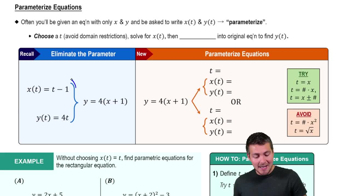
Parameterizing Equations

Chain Rule in Differentiation

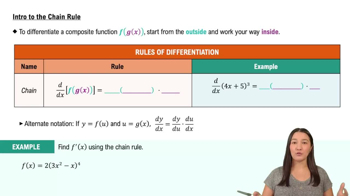
The Chain Rule allows differentiation of composite functions by relating the derivative of the outer function to the derivative of the inner function. In parametric contexts, it helps find derivatives of y with respect to x by linking dy/dt and dx/dt, crucial for expressing higher-order derivatives like y''.
Recommended video:
05:02
Intro to the Chain Rule

Second Derivative of Parametric Curves

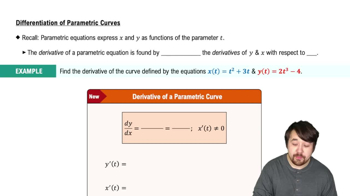
The second derivative y'' with respect to x measures the curvature of a parametric curve. It is found by differentiating dy/dx with respect to x, often using the chain rule to convert derivatives with respect to t into derivatives with respect to x. The formula involves first and second derivatives of both x and y with respect to t.
Recommended video:
06:49
Differentiation of Parametric Curves