
Textbook Question
Second derivative Assume a curve is given by the parametric equations x=f(t) and y=g(t), where f and g are twice differentiable. Use the Chain Rule to show that y″x=(fʹ(t)g″(t)−gʹ(t)f″(t))/(fʹ(t))³.

 Verified step by step guidance
 05:32
05:32
 5:33
5:33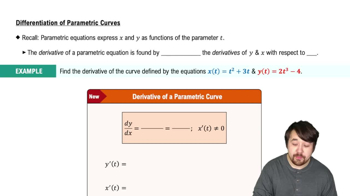 06:49
06:49Second derivative Assume a curve is given by the parametric equations x=f(t) and y=g(t), where f and g are twice differentiable. Use the Chain Rule to show that y″x=(fʹ(t)g″(t)−gʹ(t)f″(t))/(fʹ(t))³.
37–52. Curves to parametric equations Find parametric equations for the following curves. Include an interval for the parameter values. Answers are not unique.
A circle centered at the origin with radius 4, generated counterclockwise
Circles in general Show that the polar equation
r² - 2r r₀ cos(θ - θ₀) = R² - r₀²
describes a circle of radius R whose center has polar coordinates (r₀, θ₀)
45–60. Areas of regions Find the area of the following regions.
The region inside the outer loop but outside the inner loop of the limaçon r = 3 - 6 sin θ
9–13. Graph the points with the following polar coordinates. Give two alternative representations of the points in polar coordinates.
(-1, -π/3)
45–60. Areas of regions Find the area of the following regions.
The region inside the rose r = 4 sin 2θ and inside the circle r = 2