Ch.12 - Parametric and Polar Curves
Briggs - Calculus: Early Transcendentals 3rd Edition
Briggs3rd EditionCalculus: Early TranscendentalsISBN: 9780136847243Not the one you use?Change textbook
Chapter 12, Problem 12.3.51

45–60. Areas of regions Find the area of the following regions.


The region inside the rose r = 4 sin 2θ and inside the circle r = 2

Verified step by step guidance
1
First, understand the problem: we need to find the area of the region that lies both inside the rose curve given by \(r = 4 \sin 2\theta\) and inside the circle given by \(r = 2\). This means we are looking for the overlapping area between these two curves.
Next, find the points of intersection between the two curves by setting their \(r\) values equal: \(4 \sin 2\theta = 2\). Solve for \(\theta\) to determine the limits of integration for the overlapping region.
Recall that the area enclosed by a polar curve \(r(\theta)\) between angles \(\alpha\) and \(\beta\) is given by the integral \(\frac{1}{2} \int_{\alpha}^{\beta} r(\theta)^2 \, d\theta\). We will use this formula to find the areas inside each curve.
Determine which curve is inside the other in the interval between the points of intersection. The overlapping area is the integral of the smaller radius squared over the appropriate interval. Set up the integral for the area of the region inside both curves accordingly.
Finally, evaluate the integral(s) over the determined limits to find the area of the overlapping region. Remember to consider symmetry if applicable to simplify the calculation.

Verified video answer for a similar problem:

This video solution was recommended by our tutors as helpful for the problem above.
Video duration:
4m
Was this helpful?

Key Concepts

Here are the essential concepts you must grasp in order to answer the question correctly.

Polar Coordinates and Graphs

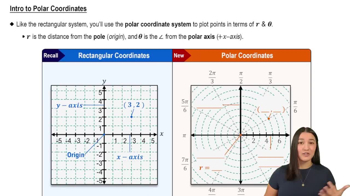
Polar coordinates represent points using a radius and an angle, useful for curves like roses and circles. Understanding how to interpret and plot equations like r = 4 sin 2θ and r = 2 is essential to visualize the regions involved.
Recommended video:
05:32
Intro to Polar Coordinates

Area Calculation in Polar Coordinates

The area enclosed by a polar curve r(θ) from θ = a to θ = b is given by (1/2) ∫[a to b] (r(θ))^2 dθ. This formula is fundamental for finding areas bounded by polar curves, including overlapping regions.
Recommended video:
05:32
Intro to Polar Coordinates

Finding Intersection Points of Polar Curves

To find the common region inside two polar curves, determine their points of intersection by equating r-values and solving for θ. These intersection points set the limits of integration for calculating the shared area.
Recommended video:
09:04
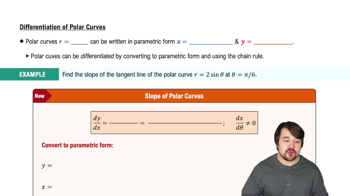
Slope of Polar Curves