
Textbook Question
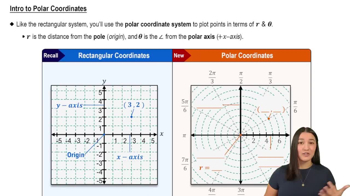
31–36. Converting coordinates Express the following Cartesian coordinates in polar coordinates in at least two different ways.
(1, √3)
1
views

 Verified step by step guidance
 05:32
05:32 05:32
05:32 6:04
6:0431–36. Converting coordinates Express the following Cartesian coordinates in polar coordinates in at least two different ways.
(1, √3)
37–52. Curves to parametric equations Find parametric equations for the following curves. Include an interval for the parameter values. Answers are not unique.
The upper half of the parabola x=y ², originating at (0, 0)
45–60. Areas of regions Find the area of the following regions.
The region inside the lemniscate r² = 6 sin 2θ
65–68. Eccentricity-directrix approach Find an equation of the following curves, assuming the center is at the origin. Graph the curve, labeling vertices, foci, asymptotes (if they exist), and directrices.
A hyperbola with vertices (0, ±2) and directrices y = ±1
27–32. Polar curves Graph the following equations.
r = 3 sin 4θ
Plot the points with polar coordinates (2, π/6) and (−3, −π/2). Give two alternative sets of coordinate pairs for both points.