Ch.12 - Parametric and Polar Curves
Briggs - Calculus: Early Transcendentals 3rd Edition
Briggs3rd EditionCalculus: Early TranscendentalsISBN: 9780136847243Not the one you use?Change textbook
Chapter 12, Problem 12.2.1

Plot the points with polar coordinates (2, π/6) and (−3, −π/2). Give two alternative sets of coordinate pairs for both points.

Verified step by step guidance
1
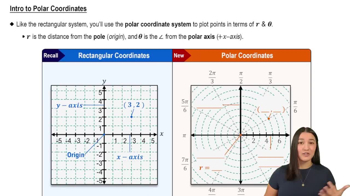
Recall that a point in polar coordinates is given by \((r, \theta)\), where \(r\) is the radius (distance from the origin) and \(\theta\) is the angle measured from the positive x-axis.
For the point \((2, \frac{\pi}{6})\), find alternative coordinates by adding \(2\pi\) to the angle or by using the negative radius with an adjusted angle. Specifically, one alternative is \((2, \frac{\pi}{6} + 2\pi)\), and another is \((-2, \frac{\pi}{6} + \pi)\).
For the point \((-3, -\frac{\pi}{2})\), similarly find alternatives by adding \(2\pi\) to the angle or by changing the sign of the radius and adjusting the angle by \(\pi\). One alternative is \((-3, -\frac{\pi}{2} + 2\pi)\), and another is \((3, -\frac{\pi}{2} + \pi)\).
Write down the two alternative coordinate pairs for each point explicitly, ensuring the angles are within a standard range (usually between \(0\) and \(2\pi\) or \(-\pi\) and \(\pi\)) if desired.
Verify that all coordinate pairs represent the same points by converting them to Cartesian coordinates using \(x = r \cos(\theta)\) and \(y = r \sin(\theta)\) if needed.

Verified video answer for a similar problem:

This video solution was recommended by our tutors as helpful for the problem above.
Video duration:
1m
Was this helpful?

Key Concepts

Here are the essential concepts you must grasp in order to answer the question correctly.

Polar Coordinates

Polar coordinates represent points in the plane using a radius and an angle, written as (r, θ). The radius r is the distance from the origin, and θ is the angle measured from the positive x-axis. Understanding how to interpret these coordinates is essential for plotting points correctly.
Recommended video:
05:32
Intro to Polar Coordinates

Equivalent Polar Coordinates

A single point in the plane can have multiple polar coordinate representations. This occurs because adding or subtracting 2π to the angle θ or changing the sign of r while adjusting θ by π results in the same point. Recognizing these equivalences helps in finding alternative coordinate pairs.
Recommended video:
05:32
Intro to Polar Coordinates

Plotting Points with Negative Radius or Angle

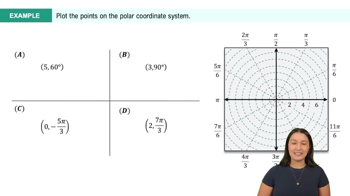
When the radius r is negative, the point is plotted in the direction opposite to the angle θ. Similarly, negative angles are measured clockwise from the positive x-axis. Understanding these conventions is crucial for accurately locating points with negative values in polar coordinates.
Recommended video:
02:13
Intro to Polar Coordinates Example 1