Back
Back
Problem 7.1.41a
In Exercises 41–44:
a. Find f⁻¹(x).
41. f(x) = 2x + 3, a = −1
Problem 7.1.43a
In Exercises 41–44:
a. Find f⁻¹(x).
43. f(x) = 5 − 4x, a = 1/2
Problem 7.1.50a
a. Show that h(x) = x³ / 4 and k(x) = (4x)^(1/3) are inverses of one another.
Problem 7.5.88a
88. Given that x>0, find the maximum value, if any, of
a. x^(1/x)
Problem 7.8.5a
5. Which of the following functions grow faster than ln(x) as x→∞? Which grow at the same rate as ln(x)? Which grow slower?
a. log_3(x)
Problem 7.5.89a
89. Use limits to find horizontal asymptotes for each function.
a. y = x tan(1/x)
Problem 7.6.141a
[Technology Exercise] In Exercises 139–141, find the domain and range of each composite function. Then graph the compositions on separate screens. Do the graphs make sense in each case? Give reasons for your answers. Comment on any differences you see.
141. a. y=arccos(cos x)
Problem 7.5.78a
78. Which one is correct, and which one is wrong? Give reasons for your answers.
a. lim (x → 0) (x² - 2x) / (x² - sin x) = lim (x → 0) (2x - 2) / (2x - cos x) = lim (x → 0) 2 / (2 + sin x) = 2 / (2 + 0) = 1
Problem 7.7.82a
82. Use the definitions of the hyperbolic functions to find each of the following limits.
a. lim(x→∞) tanh x
Problem 7.8.6a
6. Which of the following functions grow faster than ln(x) as x→∞? Which grow at the same rate as ln(x)? Which grow slower?
a. log_2(x²)
Problem 7.7.71a
Evaluate the integrals in Exercises 67–74 in terms of
a. inverse hyperbolic functions.
71. ∫(from 1/5 to 3/13)dx/(x√(1-16x²))
Problem 7.6.135a
Find the volumes of the solids in Exercises 135 and 136.
135. The solid lies between planes perpendicular to the x-axis at x=-1 and x=1. The cross-sections perpendicular to the x-axis are
a. circles whose diameters stretch from the curve y=-1/√(1+x²) to the curve y=1/√(1+x²).
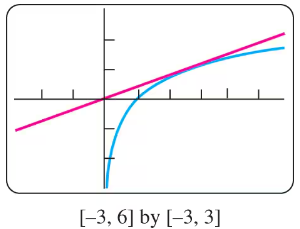
Problem 7.3.155a
155. Which is bigger, πᵉ or e^π?
Calculators have taken some of the mystery out of this once-challenging question.
(Go ahead and check; you will see that it is a very close call.)
You can answer the question without a calculator, though.
a. Find an equation for the line through the origin tangent to the graph of
y = ln(x).
Problem 7.6.139a
[Technology Exercise] In Exercises 139–141, find the domain and range of each composite function. Then graph the compositions on separate screens. Do the graphs make sense in each case? Give reasons for your answers. Comment on any differences you see.
139. a. y=arctan(tan x)
Problem 7.6.1a
Use reference triangles in an appropriate quadrant to find the angles in Exercises 1–8.
1. a. arctan 1
Problem 7.3.1a
In Exercises 1–4, solve for t.
1. a. e^(-0.3t) = 27
Problem 7.3.153a
153. The linearization of 2ˣ
a. Find the linearization of f(x) = 2ˣ at x = 0. Then round its coefficients to two decimal places.
Problem 7.7.67a
Evaluate the integrals in Exercises 67–74 in terms of
a. inverse hyperbolic functions.
67. ∫(from 0 to 2√3)dx/√(4+x²)
Problem 7.8.21a
21. a. Show that ln(x) grows slower as x→∞ than x^(1/n) for any positive integer n, even x^(1/1,000,000).
Problem 7.2.75a
75. a. Find the open intervals on which the function is increasing and decreasing.
g(x) = x(ln x)²
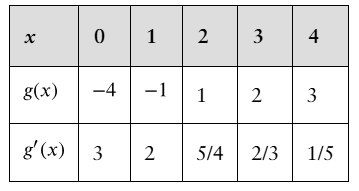
Problem 7.1.48a
Suppose that the function g and its derivative with respect to x have the following values at x=0, 1, 2, 3, and 4.
Assuming the inverse function g^(-1) is differentiable, find the slope of g^(-1)(x) at
a. x=1
Problem 7.5.77a
77. Which one is correct, and which one is wrong? Give reasons for your answers.
a. lim (x → 3) (x - 3) / (x² - 3) = lim (x → 3) 1 / (2x) = 1/6
Problem 7.6.7a
Use reference triangles in an appropriate quadrant to find the angles in Exercises 1–8.
7. a. sec^(-1)(-√2)
Problem 7.1.42a
In Exercises 41–44:
a. Find f⁻¹(x).
42. f(x) = (x + 2) / (1 − x), a = 1/2
Problem 7.3.145a
145. The linearization of eˣ at x = 0
a. Derive the linear approximation eˣ ≈ 1 + x at x = 0.
Problem 7.2.4a
4. Use the properties of logarithms to write the expressions in Exercises 3 and 4 as a single term.
a. ln secθ + ln cosθ
Problem 7.8.10.a
10. True, or false? As x→∞,
a. 1/(x+3) = O(1/x)
Problem 7.3.154a
154. The linearization of log₃x
a. Find the linearization of
f(x) = log₃x at x = 3.
Then round its coefficients to two decimal places.
Problem 7.1.72a
In Exercises 67–72, you will explore some functions and their inverses together with their derivatives and tangent line approximations at specified points. Perform the following steps using your CAS:
a. Plot the function y=f(x) together with its derivative over the given interval. Explain why you know that f is one-to-one over the interval.
72. y= 2-x-x³, -2 ≤ x ≤ 2, x_0 = 3/2
Problem 7.7.73a
Evaluate the integrals in Exercises 67–74 in terms of
a. inverse hyperbolic functions.
73. ∫(from 0 to π)cos(x)dx/√(1+sin²x)