Ch. 7 - Transcendental Functions
Hass - Thomas' Calculus 15th Edition
Hass15th EditionThomas' CalculusISBN: 9780137616077Not the one you use?Change textbook
Chapter 7, Problem 7.1.72a

In Exercises 67–72, you will explore some functions and their inverses together with their derivatives and tangent line approximations at specified points. Perform the following steps using your CAS:
a. Plot the function y=f(x) together with its derivative over the given interval. Explain why you know that f is one-to-one over the interval.
72. y= 2-x-x³, -2 ≤ x ≤ 2, x_0 = 3/2

Verified step by step guidance
1
First, identify the function given: \(y = f(x) = 2 - x - x^{3}\), defined on the interval \([-2, 2]\) with the point \(x_0 = \frac{3}{2}\).
Calculate the derivative of the function \(f(x)\) with respect to \(x\). Use the power rule for derivatives: \(f'(x) = \frac{d}{dx}(2) - \frac{d}{dx}(x) - \frac{d}{dx}(x^{3})\) which simplifies to \(f'(x) = 0 - 1 - 3x^{2} = -1 - 3x^{2}\).
Plot both the original function \(f(x)\) and its derivative \(f'(x)\) over the interval \([-2, 2]\). This visual will help you analyze the behavior of the function and its slope at different points.
To determine if \(f\) is one-to-one on the interval, examine the sign of the derivative \(f'(x)\) over \([-2, 2]\). If \(f'(x)\) does not change sign (always positive or always negative), then \(f\) is strictly monotonic and therefore one-to-one on that interval.
Finally, use the derivative at the point \(x_0 = \frac{3}{2}\) to find the slope of the tangent line at that point. Then, write the equation of the tangent line using the point-slope form: \(y - f(x_0) = f'(x_0)(x - x_0)\).

Verified video answer for a similar problem:

This video solution was recommended by our tutors as helpful for the problem above.
Video duration:
3m
Was this helpful?

Key Concepts

Here are the essential concepts you must grasp in order to answer the question correctly.

One-to-One Functions

A function is one-to-one if it never takes the same value twice, meaning each output corresponds to exactly one input. This property is essential for a function to have an inverse. Over a given interval, checking if the function is strictly increasing or decreasing helps confirm it is one-to-one.
Recommended video:
05:50
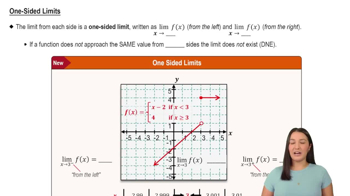
One-Sided Limits

Derivative and Monotonicity

The derivative of a function indicates its rate of change. If the derivative is positive over an interval, the function is increasing; if negative, it is decreasing. This monotonic behavior ensures the function is one-to-one on that interval, which is crucial for the existence of an inverse.
Recommended video:
05:44
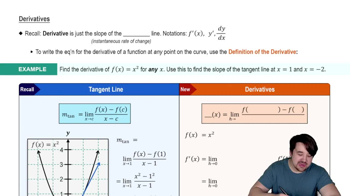
Derivatives

Tangent Line Approximation

The tangent line approximation uses the derivative at a specific point to approximate the function near that point. It is given by the equation y = f(x₀) + f'(x₀)(x - x₀), providing a linear estimate of the function’s behavior close to x₀, useful for understanding local changes.
Recommended video:
05:13
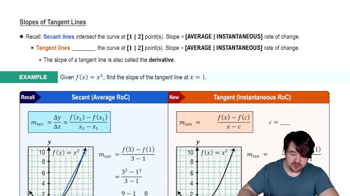
Slopes of Tangent Lines