Ch. 7 - Transcendental Functions
Hass - Thomas' Calculus 15th Edition
Hass15th EditionThomas' CalculusISBN: 9780137616077Not the one you use?Change textbook
Chapter 7, Problem 7.3.155a

155. Which is bigger, πᵉ or e^π?
Calculators have taken some of the mystery out of this once-challenging question.
(Go ahead and check; you will see that it is a very close call.)
You can answer the question without a calculator, though.
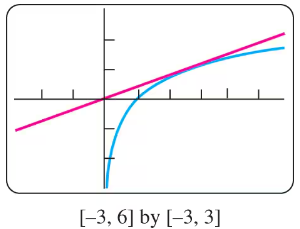
a. Find an equation for the line through the origin tangent to the graph of
y = ln(x).
img

Verified step by step guidance
1
Identify the function given: \(y = \ln(x)\).
Find the derivative of \(y = \ln(x)\) to get the slope of the tangent line at any point \(x\). The derivative is \(y' = \frac{1}{x}\).
Since the tangent line passes through the origin (0,0), find the point of tangency \(x = a\) where the tangent line touches the curve \(y = \ln(x)\).
The slope of the tangent line at \(x = a\) is \(\frac{1}{a}\), and the tangent line passes through \((a, \ln(a))\) and the origin \((0,0)\).
Use the point-slope form of the line through the origin with slope \(\frac{1}{a}\): \(y = \frac{1}{a} x\). This line is tangent to \(y = \ln(x)\) at \(x = a\).

Verified video answer for a similar problem:

This video solution was recommended by our tutors as helpful for the problem above.
Video duration:
5m
Was this helpful?

Key Concepts

Here are the essential concepts you must grasp in order to answer the question correctly.

Comparing Exponential Expressions

To compare expressions like π^e and e^π without a calculator, use logarithms to transform the comparison into a difference of products involving natural logs. This approach leverages properties of exponents and logarithms to analyze which value is larger.
Recommended video:
Guided course
6:39
Simplifying Exponential Expressions

Tangent Line to a Curve

A tangent line to a curve at a point touches the curve without crossing it locally and has the same slope as the curve at that point. For y = ln(x), the slope at any x is given by the derivative 1/x, which helps find the equation of the tangent line.
Recommended video:
05:13
Slopes of Tangent Lines

Derivative of the Natural Logarithm Function

The derivative of y = ln(x) is y' = 1/x, which gives the slope of the tangent line at any point x > 0. This derivative is essential for finding tangent lines and understanding the behavior of the logarithmic function.
Recommended video:
05:18
Derivative of the Natural Logarithmic Function