Ch. 7 - Transcendental Functions
Hass - Thomas' Calculus 15th Edition
Hass15th EditionThomas' CalculusISBN: 9780137616077Not the one you use?Change textbook
Chapter 7, Problem 7.6.3a

Use reference triangles in an appropriate quadrant to find the angles in Exercises 1–8.
3. a. arcsin(-1/2)

Verified step by step guidance
1
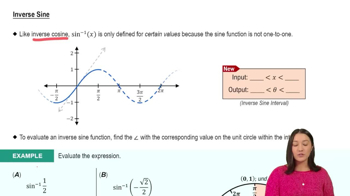
Recall that \(\arcsin(x)\) is the inverse sine function, which returns an angle \(\theta\) such that \(\sin(\theta) = x\) and \(\theta\) lies in the range \([-\frac{\pi}{2}, \frac{\pi}{2}]\) (Quadrants IV and I).
Identify the value inside the arcsin: here it is \(-\frac{1}{2}\). We want to find an angle \(\theta\) where \(\sin(\theta) = -\frac{1}{2}\) within the allowed range of \(\arcsin\).
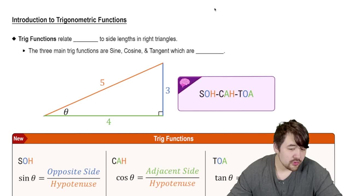
Recall the reference angle for \(\sin(\theta) = \frac{1}{2}\) is \(\frac{\pi}{6}\) (or 30 degrees). The reference triangle has an opposite side of 1 and hypotenuse of 2.
Since the sine value is negative, and \(\arcsin\) outputs angles between \(-\frac{\pi}{2}\) and \(\frac{\pi}{2}\), the angle must be in Quadrant IV (negative angles). So, the angle is \(-\frac{\pi}{6}\).
Express the final answer as \(\theta = -\frac{\pi}{6}\), which corresponds to the angle whose sine is \(-\frac{1}{2}\) in the range of \(\arcsin\).

Verified video answer for a similar problem:

This video solution was recommended by our tutors as helpful for the problem above.
Video duration:
1m
Was this helpful?

Key Concepts

Here are the essential concepts you must grasp in order to answer the question correctly.

Inverse Sine Function (arcsin)

The inverse sine function, arcsin, returns the angle whose sine value is a given number. Its range is limited to angles between -π/2 and π/2 (or -90° to 90°), meaning the principal value lies within this interval. Understanding arcsin helps find the reference angle corresponding to a sine value.
Recommended video:
4:03
Inverse Sine

Reference Triangles

Reference triangles are right triangles used to determine the exact angle measures related to trigonometric values. By considering the absolute value of the sine and the triangle’s side ratios, one can find the reference angle, which is then adjusted based on the quadrant to find the actual angle.
Recommended video:
6:04
Introduction to Trigonometric Functions

Quadrants and Sign of Trigonometric Functions

The sign of sine varies by quadrant: positive in Quadrants I and II, negative in III and IV. Since arcsin outputs angles in Quadrants I and IV, for a negative sine value like -1/2, the angle lies in Quadrant IV. Recognizing the correct quadrant ensures the angle corresponds to the given sine value.
Recommended video:
6:04
Introduction to Trigonometric Functions