Ch. 7 - Transcendental Functions
Hass - Thomas' Calculus 15th Edition
Hass15th EditionThomas' CalculusISBN: 9780137616077Not the one you use?Change textbook
Chapter 7, Problem 7.2.84a

84.a. Find the center of mass of a thin plate of constant density covering the region between the curve y=1/√x and the x-axis from x=1 to x=16.

Verified step by step guidance
1
Identify the region and the density: The plate has constant density, so we can denote the density as \( \rho \) (a constant). The region is bounded by the curve \( y = \frac{1}{\sqrt{x}} \), the x-axis \( y=0 \), and the vertical lines \( x=1 \) and \( x=16 \).
Set up the expressions for the area and moments: Since the density is constant, the mass \( M \) is proportional to the area of the region. The area \( A \) is given by the integral \( A = \int_{1}^{16} \frac{1}{\sqrt{x}} \, dx \).
Find the coordinates of the center of mass \( (\bar{x}, \bar{y}) \): Use the formulas for the centroid of a lamina with constant density: \[ \bar{x} = \frac{1}{A} \int_{1}^{16} x \cdot \frac{1}{\sqrt{x}} \, dx \] \[ \bar{y} = \frac{1}{2A} \int_{1}^{16} \left( \frac{1}{\sqrt{x}} \right)^2 \, dx \] Note that \( \bar{y} \) uses the average height of the region, which is the moment about the x-axis divided by the area.
Evaluate the integrals step-by-step: - For the area \( A \), integrate \( \int_{1}^{16} x^{-1/2} \, dx \). - For \( \bar{x} \), integrate \( \int_{1}^{16} x^{1/2} \, dx \). - For \( \bar{y} \), integrate \( \int_{1}^{16} x^{-1} \, dx \).
After computing the integrals, substitute the results back into the formulas for \( \bar{x} \) and \( \bar{y} \) to find the coordinates of the center of mass.

Verified video answer for a similar problem:

This video solution was recommended by our tutors as helpful for the problem above.
Video duration:
10m
Was this helpful?

Key Concepts

Here are the essential concepts you must grasp in order to answer the question correctly.

Center of Mass for a Lamina

The center of mass of a thin plate (lamina) with constant density is the point where the plate would balance perfectly. It is found by calculating the coordinates (x̄, ȳ), which are the weighted averages of the x and y positions, using integrals of the region's shape and density.
Recommended video:
09:32
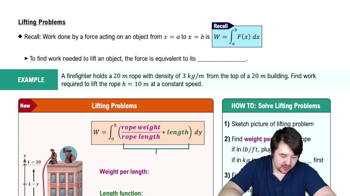
Lifting Problems

Definite Integrals for Area and Moments

Definite integrals are used to compute the area of the region and the moments about the coordinate axes. The area integral involves integrating the function defining the boundary, while the moments involve integrating the product of the coordinate and the function over the given interval.
Recommended video:
05:43
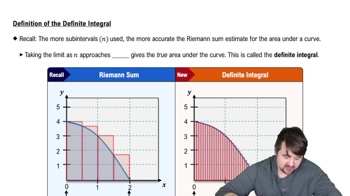
Definition of the Definite Integral

Function and Region Description

Understanding the region bounded by y = 1/√x and the x-axis from x=1 to x=16 is essential. This involves recognizing the curve's behavior, setting up the correct limits of integration, and interpreting the region to apply the formulas for area and moments accurately.
Recommended video:
07:45
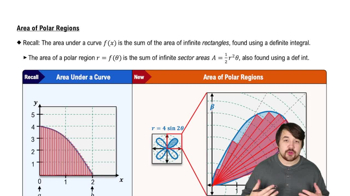
Area of Polar Regions
Related Practice
Textbook Question

80. Find all values of c that satisfy the conclusion of Cauchy's Mean Value Theorem for the given functions and interval.

a. f(x) = x, g(x) = x², (a, b) = (-2, 0)

Textbook Question

6. Which of the following functions grow faster than ln(x) as x→∞? Which grow at the same rate as ln(x)? Which grow slower?

a. log_2(x²)

Textbook Question

Find the volumes of the solids in Exercises 135 and 136.

135. The solid lies between planes perpendicular to the x-axis at x=-1 and x=1. The cross-sections perpendicular to the x-axis are

a. circles whose diameters stretch from the curve y=-1/√(1+x²) to the curve y=1/√(1+x²).

1
views
Textbook Question

155. Which is bigger, πᵉ or e^π?

Calculators have taken some of the mystery out of this once-challenging question.

(Go ahead and check; you will see that it is a very close call.)

You can answer the question without a calculator, though.

a. Find an equation for the line through the origin tangent to the graph of

y = ln(x).

Textbook Question

In Exercises 67–72, you will explore some functions and their inverses together with their derivatives and tangent line approximations at specified points. Perform the following steps using your CAS:

a. Plot the function y=f(x) together with its derivative over the given interval. Explain why you know that f is one-to-one over the interval.

72. y= 2-x-x³, -2 ≤ x ≤ 2, x_0 = 3/2

Textbook Question

Evaluate the integrals in Exercises 67–74 in terms of

a. inverse hyperbolic functions.

69. ∫(from 5/4 to 2)dx/(1-x²)