Ch. 7 - Transcendental Functions
Hass - Thomas' Calculus 15th Edition
Hass15th EditionThomas' CalculusISBN: 9780137616077Not the one you use?Change textbook
Chapter 7, Problem 7.6.135a

Find the volumes of the solids in Exercises 135 and 136.
135. The solid lies between planes perpendicular to the x-axis at x=-1 and x=1. The cross-sections perpendicular to the x-axis are
a. circles whose diameters stretch from the curve y=-1/√(1+x²) to the curve y=1/√(1+x²).

Verified step by step guidance
1
Identify the interval over which the solid extends along the x-axis, which is from \(x = -1\) to \(x = 1\).
Determine the length of the diameter of each circular cross-section at a given \(x\). The diameter stretches from \(y = -\frac{1}{\sqrt{1+x^2}}\) to \(y = \frac{1}{\sqrt{1+x^2}}\), so the diameter length is the difference between these two values.
Calculate the diameter length as \(D(x) = \frac{1}{\sqrt{1+x^2}} - \left(-\frac{1}{\sqrt{1+x^2}}\right) = \frac{2}{\sqrt{1+x^2}}\).
Find the radius of the circular cross-section as half the diameter: \(r(x) = \frac{D(x)}{2} = \frac{1}{\sqrt{1+x^2}}\).
Write the formula for the volume of the solid using the integral of the cross-sectional area: \(V = \int_{-1}^{1} \pi [r(x)]^2 \, dx = \int_{-1}^{1} \pi \left(\frac{1}{\sqrt{1+x^2}}\right)^2 \, dx\).

Verified video answer for a similar problem:

This video solution was recommended by our tutors as helpful for the problem above.
Video duration:
9m
Was this helpful?

Key Concepts

Here are the essential concepts you must grasp in order to answer the question correctly.

Volume of a Solid with Known Cross-Sections

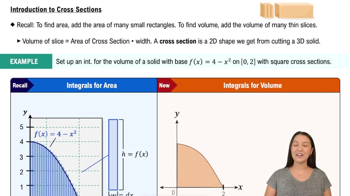
To find the volume of a solid with cross-sections perpendicular to an axis, integrate the area of each cross-section along that axis. The volume V is given by V = ∫ A(x) dx, where A(x) is the area of the cross-section at position x. This method applies when the shape of the cross-section is known as a function of x.
Recommended video:
05:38
Introduction to Cross Sections

Area of a Circle from Diameter

The area of a circle is A = πr², where r is the radius. If the diameter d is known, the radius is r = d/2, so the area becomes A = π(d/2)² = (π/4)d². In this problem, the diameter is the vertical distance between two curves, which varies with x.
Recommended video:
05:06
Finding Area When Bounds Are Not Given

Using Curves to Determine Cross-Section Dimensions

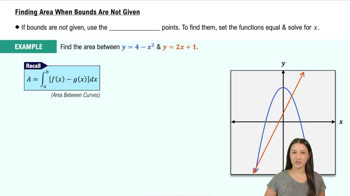
The diameter of each circular cross-section is the distance between two curves y = f(x) and y = g(x). This distance is |f(x) - g(x)|. Here, the curves y = 1/√(1+x²) and y = -1/√(1+x²) define the endpoints of the diameter, so the diameter is the vertical distance between these two functions at each x.
Recommended video:
05:38
Introduction to Cross Sections