Ch. 7 - Transcendental Functions
Hass - Thomas' Calculus 15th Edition
Hass15th EditionThomas' CalculusISBN: 9780137616077Not the one you use?Change textbook
Chapter 7, Problem 7.5.88a

88. Given that x>0, find the maximum value, if any, of
a. x^(1/x)

Verified step by step guidance
1
Identify the function to maximize: \(f(x) = x^{\frac{1}{x}}\) with the domain \(x > 0\).
Rewrite the function using the natural logarithm to simplify differentiation: consider \(y = x^{\frac{1}{x}}\), then take the natural log to get \(\ln y = \frac{1}{x} \ln x\).
Differentiate both sides with respect to \(x\) using implicit differentiation: \(\frac{1}{y} \frac{dy}{dx} = \frac{d}{dx} \left( \frac{\ln x}{x} \right)\).
Apply the quotient rule to differentiate \(\frac{\ln x}{x}\): \(\frac{d}{dx} \left( \frac{\ln x}{x} \right) = \frac{(\frac{1}{x}) \cdot x - \ln x \cdot 1}{x^2} = \frac{1 - \ln x}{x^2}\).
Set the derivative \(\frac{dy}{dx}\) equal to zero to find critical points: since \(\frac{dy}{dx} = y \cdot \frac{1 - \ln x}{x^2}\), solve \(1 - \ln x = 0\) to find \(x = e\). Then analyze the behavior around \(x = e\) to determine if it is a maximum.

Verified video answer for a similar problem:

This video solution was recommended by our tutors as helpful for the problem above.
Video duration:
9m
Was this helpful?

Key Concepts

Here are the essential concepts you must grasp in order to answer the question correctly.

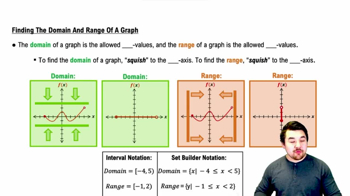
Function Analysis and Domain

Understanding the behavior of the function f(x) = x^(1/x) for x > 0 is essential. This involves recognizing the domain restrictions and how the function behaves as x approaches 0 and infinity, which helps in identifying potential maxima or minima.
Recommended video:
5:10
Finding the Domain and Range of a Graph

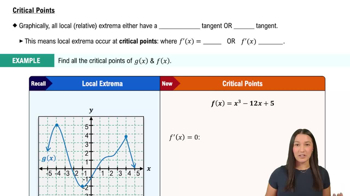
Differentiation and Critical Points

To find the maximum value of the function, we use differentiation to find critical points where the derivative equals zero or is undefined. These points are candidates for local maxima or minima and are crucial for optimization problems.
Recommended video:
04:50
Critical Points

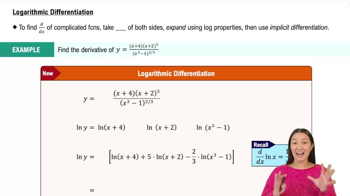
Logarithmic Differentiation

Since the function involves a variable exponent, logarithmic differentiation simplifies the process. Taking the natural logarithm of f(x) = x^(1/x) transforms it into a product, making it easier to differentiate and solve for critical points.
Recommended video:
06:30
Logarithmic Differentiation