Ch. 7 - Transcendental Functions
Hass - Thomas' Calculus 15th Edition
Hass15th EditionThomas' CalculusISBN: 9780137616077Not the one you use?Change textbook
Chapter 7, Problem 7.4.1a

In Exercises 1–4, show that each function y=f(x) is a solution of the accompanying differential equation.
1. 2y' + 3y = e^(-x)
a. y = e^(-x)

Verified step by step guidance
1
Identify the given differential equation: \(2y' + 3y = e^{-x}\).
Given the function \(y = e^{-x}\), find its derivative \(y'\) with respect to \(x\). Recall that the derivative of \(e^{-x}\) is \(-e^{-x}\), so \(y' = -e^{-x}\).
Substitute \(y = e^{-x}\) and \(y' = -e^{-x}\) into the left-hand side of the differential equation: \(2y' + 3y = 2(-e^{-x}) + 3(e^{-x})\).
Simplify the expression: \(2(-e^{-x}) + 3(e^{-x}) = -2e^{-x} + 3e^{-x} = ( -2 + 3 ) e^{-x} = e^{-x}\).
Since the left-hand side simplifies to \(e^{-x}\), which matches the right-hand side of the differential equation, this shows that \(y = e^{-x}\) is indeed a solution.

Verified video answer for a similar problem:

This video solution was recommended by our tutors as helpful for the problem above.
Video duration:
1m
Was this helpful?

Key Concepts

Here are the essential concepts you must grasp in order to answer the question correctly.

Differential Equations

A differential equation relates a function with its derivatives. Solving it means finding a function that satisfies this relationship. In this problem, verifying a solution involves substituting the given function and its derivative into the equation to check if both sides are equal.
Recommended video:
07:39
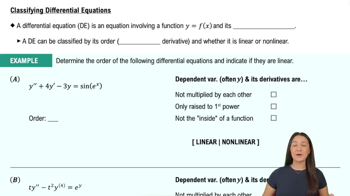
Classifying Differential Equations

Derivative of Exponential Functions

The derivative of an exponential function like e^(-x) is found using the chain rule. Specifically, d/dx[e^(-x)] = -e^(-x). Understanding this derivative is essential to correctly substitute y' in the differential equation.
Recommended video:
04:50
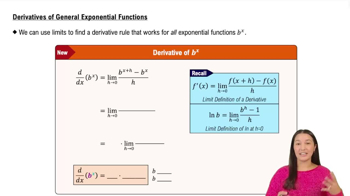
Derivatives of General Exponential Functions

Verification of Solutions

To verify a proposed solution to a differential equation, substitute the function and its derivative into the equation. If the left-hand side equals the right-hand side for all x in the domain, the function is a valid solution.
Recommended video:
04:00
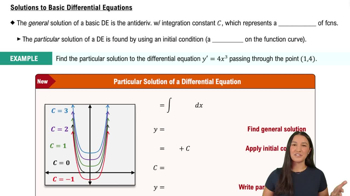
Solutions to Basic Differential Equations