Ch. 7 - Transcendental Functions
Hass - Thomas' Calculus 15th Edition
Hass15th EditionThomas' CalculusISBN: 9780137616077Not the one you use?Change textbook
Chapter 7, Problem 7.1.48a

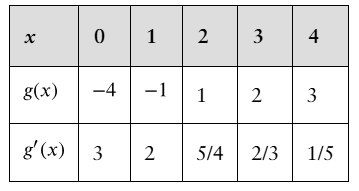
Suppose that the function g and its derivative with respect to x have the following values at x=0, 1, 2, 3, and 4.
Assuming the inverse function g^(-1) is differentiable, find the slope of g^(-1)(x) at
a. x=1
Table showing values of a function g and its derivative g' at x = 0 to 4 for finding the inverse function's slope at x=1.

Verified step by step guidance
1
Recall that the slope of the inverse function \( g^{-1}(x) \) at a point \( x = a \) is given by the formula: \[ \left( g^{-1} \right)'(a) = \frac{1}{g'\left( g^{-1}(a) \right)} \] This means we need to find the derivative of \( g \) at the point where \( g(x) = a \).
For part (a), we want to find the slope of \( g^{-1}(x) \) at \( x = 1 \). First, find the value of \( x \) such that \( g(x) = 1 \) by looking at the table. From the table, \( g(2) = 1 \), so \( g^{-1}(1) = 2 \).
Next, find \( g'(x) \) at \( x = 2 \) from the table. The value is \( g'(2) = \frac{5}{4} \).
Now, apply the formula for the derivative of the inverse function: \[ \left( g^{-1} \right)'(1) = \frac{1}{g'(2)} = \frac{1}{\frac{5}{4}} \]
Simplify the expression to find the slope of \( g^{-1}(x) \) at \( x = 1 \). This completes the process to find the slope without calculating the final numeric value.

Verified video answer for a similar problem:

This video solution was recommended by our tutors as helpful for the problem above.
Video duration:
3m
Was this helpful?

Key Concepts

Here are the essential concepts you must grasp in order to answer the question correctly.

Inverse Function and Its Differentiability

An inverse function g⁻¹ reverses the effect of the original function g, such that g(g⁻¹(x)) = x. For g⁻¹ to be differentiable at a point, g must be continuous and have a non-zero derivative at the corresponding point, ensuring the inverse function's slope exists and is well-defined.
Recommended video:
06:35
Derivatives of Other Inverse Trigonometric Functions

Derivative of the Inverse Function

The derivative of the inverse function at a point x is given by (g⁻¹)'(x) = 1 / g'(g⁻¹(x)). This formula relates the slope of the inverse function to the slope of the original function at the corresponding input, allowing calculation of the inverse slope using known values of g and g'.
Recommended video:
06:35
Derivatives of Other Inverse Trigonometric Functions

Using Tabulated Values to Find the Slope

Given a table of values for g(x) and g'(x), find the input a where g(a) = x, then use g'(a) to compute (g⁻¹)'(x) = 1 / g'(a). This approach leverages discrete data points to determine the slope of the inverse function at specific x-values.
Recommended video:
04:09
Understanding Slope Fields Example 2