Ch. 7 - Transcendental Functions
Hass - Thomas' Calculus 15th Edition
Hass15th EditionThomas' CalculusISBN: 9780137616077Not the one you use?Change textbook
Chapter 7, Problem 7.1.47b

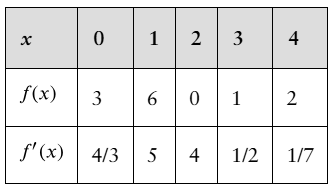
Suppose that the function f and its derivative with respect to x have the following values at x=0, 1, 2, 3, and 4.
Assuming the inverse function f^(-1) is differentiable, find the slope of f^(-1)(x) at
b. x=2
Table showing values of x, f(x), and f prime(x) at points 0 to 4, used to find the slope of the inverse function at x=2.

Verified step by step guidance
1
Identify the value of \(b\) for which we want to find the slope of the inverse function \(f^{-1}(x)\). Here, \(b = 2\).
Recall the formula for the derivative of the inverse function: \(\left(f^{-1}\right)'(b) = \frac{1}{f'(a)}\) where \(a = f^{-1}(b)\), meaning \(f(a) = b\).
From the table, find the value of \(a\) such that \(f(a) = 2\). Looking at the \(f(x)\) row, \(f(4) = 2\), so \(a = 4\).
Find \(f'(a)\) from the table. For \(a = 4\), \(f'(4) = \frac{1}{7}\).
Use the formula to find the slope of the inverse function at \(x = 2\): \(\left(f^{-1}\right)'(2) = \frac{1}{f'(4)} = \frac{1}{\frac{1}{7}}\).

Verified video answer for a similar problem:

This video solution was recommended by our tutors as helpful for the problem above.
Video duration:
3m
Was this helpful?

Key Concepts

Here are the essential concepts you must grasp in order to answer the question correctly.

Inverse Function and Its Differentiability

An inverse function f^(-1) reverses the effect of the original function f, such that f(f^(-1)(x)) = x. For the inverse to be differentiable at a point, the original function must be one-to-one and have a non-zero derivative at the corresponding point. This ensures the inverse function's slope exists and can be calculated.
Recommended video:
06:35
Derivatives of Other Inverse Trigonometric Functions

Derivative of the Inverse Function

The derivative of the inverse function at a point x = b is given by (f^(-1))'(b) = 1 / f'(a), where a = f^(-1)(b). This formula relates the slope of the inverse function to the slope of the original function at the corresponding point, allowing us to find the slope of the inverse using known values of f and f'.
Recommended video:
06:35
Derivatives of Other Inverse Trigonometric Functions

Using Tabulated Values to Find the Slope

Given a table of values for x, f(x), and f'(x), we identify the x-value a such that f(a) = b. Then, we use the derivative f'(a) to compute the slope of the inverse at x = b. This method applies the inverse derivative formula directly using discrete data points.
Recommended video:
04:09
Understanding Slope Fields Example 2