

Ch. 7 - Transcendental Functions
Hass - Thomas' Calculus 15th Edition
Hass15th EditionThomas' CalculusISBN: 9780137616077Not the one you use?Change textbook
Chapter 7, Problem 7.7.67b

Evaluate the integrals in Exercises 67–74 in terms of
b. natural logarithms.
67. ∫(from 0 to 2√3)dx/√(4+x²)

Verified step by step guidance
1
Recognize that the integral is of the form \(\int \frac{dx}{\sqrt{a^2 + x^2}}\), where \(a = 2\) in this case.
Recall the standard integral formula: \(\int \frac{dx}{\sqrt{a^2 + x^2}} = \ln \left| x + \sqrt{x^2 + a^2} \right| + C\).
Apply the definite integral limits from \(0\) to \(2\sqrt{3}\), so write the expression as \(\left[ \ln \left( x + \sqrt{x^2 + 4} \right) \right]_0^{2\sqrt{3}}\).
Evaluate the expression at the upper limit \(x = 2\sqrt{3}\) and at the lower limit \(x = 0\) separately.
Subtract the value at the lower limit from the value at the upper limit to get the final answer in terms of natural logarithms.

Verified video answer for a similar problem:

This video solution was recommended by our tutors as helpful for the problem above.
Video duration:
5m
Was this helpful?

Key Concepts

Here are the essential concepts you must grasp in order to answer the question correctly.

Definite Integrals

A definite integral calculates the net area under a curve between two specific limits. It involves evaluating the antiderivative at the upper and lower bounds and subtracting these values to find the exact accumulated quantity.
Recommended video:
05:43
Definition of the Definite Integral

Integration of Functions Involving √(a² + x²)

Integrals of the form ∫dx/√(a² + x²) often use trigonometric substitution or recognize standard integral formulas. The antiderivative typically involves inverse hyperbolic functions or natural logarithms, such as ln|x + √(x² + a²)|.
Recommended video:
07:01
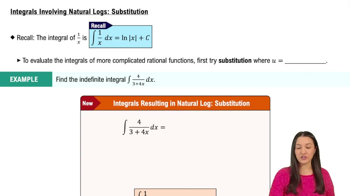
Integrals Involving Natural Logs: Substitution

Natural Logarithms in Integration

Natural logarithms frequently appear in integrals involving rational functions and roots. They provide a way to express antiderivatives of functions like 1/√(a² + x²), linking algebraic expressions to logarithmic forms for easier evaluation.
Recommended video:
05:18
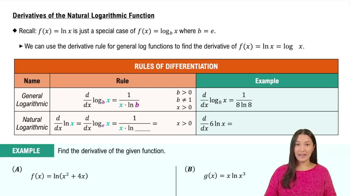
Derivative of the Natural Logarithmic Function