
Ch. 7 - Transcendental Functions
Hass - Thomas' Calculus 15th Edition
Hass15th EditionThomas' CalculusISBN: 9780137616077Not the one you use?Change textbook
Chapter 7, Problem 7.2.2b

2. Express the following logarithms in terms of ln 5 and ln 7.
b. ln 9.8

Verified step by step guidance
1
Start by expressing 9.8 as a product or quotient of numbers involving 5 and 7. Notice that 9.8 can be written as \( 9.8 = \frac{49}{5} \) because \( 49 = 7^2 \) and \( 9.8 = 9.8 \).
Rewrite \( \ln 9.8 \) using the expression found: \( \ln 9.8 = \ln \left( \frac{49}{5} \right) \).
Use the logarithm property for division: \( \ln \left( \frac{a}{b} \right) = \ln a - \ln b \). So, \( \ln 9.8 = \ln 49 - \ln 5 \).
Express \( \ln 49 \) in terms of \( \ln 7 \) using the power rule for logarithms: \( \ln 49 = \ln (7^2) = 2 \ln 7 \).
Combine all parts to write \( \ln 9.8 \) fully in terms of \( \ln 5 \) and \( \ln 7 \): \( \ln 9.8 = 2 \ln 7 - \ln 5 \).

Verified video answer for a similar problem:

This video solution was recommended by our tutors as helpful for the problem above.
Video duration:
1m
Was this helpful?

Key Concepts

Here are the essential concepts you must grasp in order to answer the question correctly.

Properties of Logarithms

Logarithmic properties such as the product, quotient, and power rules allow us to rewrite logarithms of complex numbers in terms of simpler components. For example, ln(ab) = ln a + ln b and ln(a^n) = n ln a. These properties are essential for expressing ln 9.8 in terms of ln 5 and ln 7.
Recommended video:
05:36
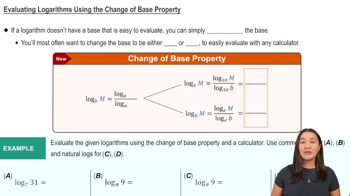
Change of Base Property

Prime Factorization and Approximation

Breaking down numbers into products of prime factors or close approximations helps in rewriting logarithms. Since 9.8 is not a simple product of 5 and 7, approximating or expressing 9.8 as a product or quotient involving 5 and 7 is necessary to use known logarithms effectively.
Recommended video:
11:15
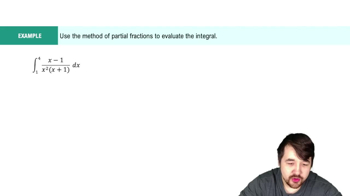
Partial Fraction Decomposition: Repeated Linear Factors Example 4

Natural Logarithm (ln) Definition

The natural logarithm ln x is the logarithm to the base e, where e is Euler's number (~2.718). Understanding ln as the inverse of the exponential function helps in manipulating and combining logarithmic expressions, especially when expressing one logarithm in terms of others.
Recommended video:
05:18
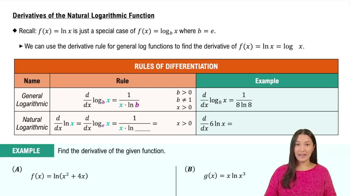
Derivative of the Natural Logarithmic Function