Ch. 7 - Transcendental Functions
Hass - Thomas' Calculus 15th Edition
Hass15th EditionThomas' CalculusISBN: 9780137616077Not the one you use?Change textbook
Chapter 7, Problem 7.2.71b

71. Locate and identify the absolute extreme values of cos(ln x) on [1/2, 2]

Verified step by step guidance
1
First, understand that the function to analyze is \(f(x) = \cos(\ln x)\) on the interval \(\left[ \frac{1}{2}, 2 \right]\). We want to find the absolute maximum and minimum values on this closed interval.
Step 1: Find the derivative of the function to locate critical points. Using the chain rule, the derivative is \(f'(x) = -\sin(\ln x) \cdot \frac{1}{x}\).
Step 2: Set the derivative equal to zero to find critical points inside the interval: \(-\sin(\ln x) \cdot \frac{1}{x} = 0\). Since \(\frac{1}{x} \neq 0\) for \(x > 0\), this reduces to \(\sin(\ln x) = 0\).
Step 3: Solve \(\sin(\ln x) = 0\) for \(x\) in \(\left[ \frac{1}{2}, 2 \right]\). Recall that \(\sin t = 0\) when \(t = k\pi\) for any integer \(k\). So, set \(\ln x = k\pi\) and solve for \(x = e^{k\pi}\), then determine which values lie in the interval.
Step 4: Evaluate the function \(f(x) = \cos(\ln x)\) at all critical points found in the interval and also at the endpoints \(x = \frac{1}{2}\) and \(x = 2\). Compare these values to identify the absolute maximum and minimum.

Verified video answer for a similar problem:

This video solution was recommended by our tutors as helpful for the problem above.
Video duration:
12m
Was this helpful?

Key Concepts

Here are the essential concepts you must grasp in order to answer the question correctly.

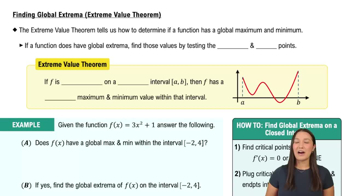
Absolute Extreme Values

Absolute extreme values are the highest or lowest values a function attains on a given closed interval. These include absolute maxima and minima, which can occur at critical points or endpoints of the interval.
Recommended video:
05:12
Finding Global Extrema (Extreme Value Theorem)

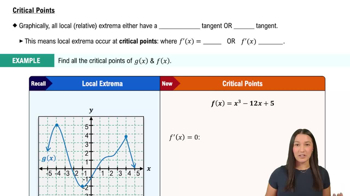
Critical Points and Derivatives

Critical points occur where the derivative of a function is zero or undefined. Finding these points helps identify potential locations of extreme values within the interval.
Recommended video:
04:50
Critical Points

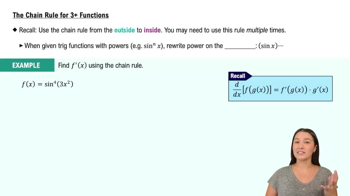
Chain Rule and Differentiation of Composite Functions

The chain rule is used to differentiate composite functions like cos(ln x). It involves differentiating the outer function and multiplying by the derivative of the inner function, essential for finding the derivative of cos(ln x).
Recommended video:
03:58
The Chain Rule for 3+ Functions