Ch. 7 - Transcendental Functions
Hass - Thomas' Calculus 15th Edition
Hass15th EditionThomas' CalculusISBN: 9780137616077Not the one you use?Change textbook
Chapter 7, Problem 7.3.131b

131. Let f(x) = x * e^(−x).
b. Find all inflection points for f.

Verified step by step guidance
1
Recall that inflection points occur where the concavity of the function changes, which means where the second derivative changes sign. So, first, we need to find the second derivative of the function \(f(x) = x \cdot e^{-x}\).
Start by finding the first derivative \(f'(x)\). Use the product rule: if \(f(x) = u(x) \cdot v(x)\), then \(f'(x) = u'(x) \cdot v(x) + u(x) \cdot v'(x)\). Here, \(u(x) = x\) and \(v(x) = e^{-x}\).
Calculate \(u'(x) = 1\) and \(v'(x) = -e^{-x}\) (using the chain rule). Substitute these into the product rule formula to get \(f'(x) = 1 \cdot e^{-x} + x \cdot (-e^{-x})\).
Simplify \(f'(x)\) to \(f'(x) = e^{-x} - x e^{-x} = e^{-x}(1 - x)\). Next, find the second derivative \(f''(x)\) by differentiating \(f'(x)\) again, applying the product rule to \(e^{-x}(1 - x)\).
Set \(f''(x) = 0\) and solve for \(x\) to find potential inflection points. Then, check the sign of \(f''(x)\) on intervals around these points to confirm where the concavity changes, identifying the inflection points.

Verified video answer for a similar problem:

This video solution was recommended by our tutors as helpful for the problem above.
Video duration:
7m
Was this helpful?

Key Concepts

Here are the essential concepts you must grasp in order to answer the question correctly.

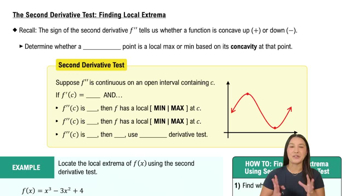
Second Derivative and Concavity

The second derivative of a function measures the curvature or concavity of its graph. If the second derivative is positive on an interval, the graph is concave up; if negative, concave down. Inflection points occur where the concavity changes, typically where the second derivative equals zero or is undefined.
Recommended video:
06:02
The Second Derivative Test: Finding Local Extrema

Finding Inflection Points

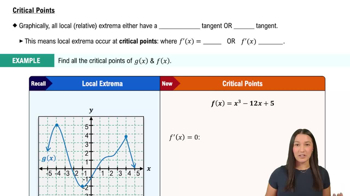
To find inflection points, first compute the second derivative of the function, then solve for points where it equals zero or does not exist. Finally, verify that the concavity changes sign around these points to confirm they are true inflection points.
Recommended video:
04:50
Critical Points

Product Rule for Differentiation

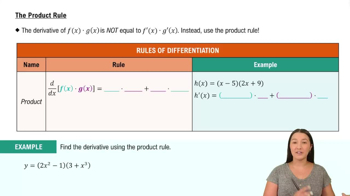
Since f(x) = x * e^(−x) is a product of two functions, the product rule is used to find its derivatives. The product rule states that the derivative of u(x)v(x) is u'(x)v(x) + u(x)v'(x), which is essential for correctly computing the first and second derivatives.
Recommended video:
05:18
The Product Rule