Ch. 7 - Transcendental Functions
Hass - Thomas' Calculus 15th Edition
Hass15th EditionThomas' CalculusISBN: 9780137616077Not the one you use?Change textbook
Chapter 7, Problem 7.6.8b

Use reference triangles in an appropriate quadrant to find the angles in Exercises 1–8.
8. b. arccot(√3)

Verified step by step guidance
1
Recall that \( \arccot(x) \) is the angle \( \theta \) such that \( \cot(\theta) = x \). Here, we want to find \( \theta = \arccot(\sqrt{3}) \).
Use the definition of cotangent in terms of sine and cosine: \( \cot(\theta) = \frac{\cos(\theta)}{\sin(\theta)} \). So, we need to find an angle \( \theta \) where \( \frac{\cos(\theta)}{\sin(\theta)} = \sqrt{3} \).
Recognize that \( \cot(\theta) = \sqrt{3} \) corresponds to a reference triangle where the adjacent side is \( \sqrt{3} \) and the opposite side is 1. This is a 30°-60°-90° triangle, where \( \cot(30^\circ) = \sqrt{3} \).
Determine the quadrant for \( \arccot(\sqrt{3}) \). Since \( \sqrt{3} > 0 \), \( \theta \) lies in the first quadrant where cotangent is positive.
Conclude that \( \arccot(\sqrt{3}) \) is the angle in the first quadrant with reference angle 30°, so \( \theta = 30^\circ \) or in radians \( \theta = \frac{\pi}{6} \).

Verified video answer for a similar problem:

This video solution was recommended by our tutors as helpful for the problem above.
Video duration:
2m
Was this helpful?

Key Concepts

Here are the essential concepts you must grasp in order to answer the question correctly.

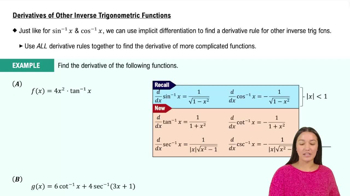
Inverse Trigonometric Functions

Inverse trigonometric functions, like arccot, return the angle whose trigonometric ratio equals a given value. For arccot(√3), we seek an angle whose cotangent is √3. Understanding their ranges and outputs is essential for correctly identifying the angle.
Recommended video:
06:35
Derivatives of Other Inverse Trigonometric Functions

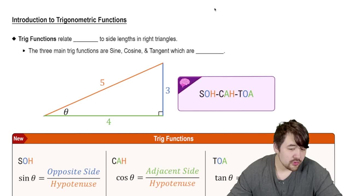
Reference Triangles

Reference triangles are right triangles used to relate trigonometric ratios to specific angles. By constructing a triangle with sides matching the given ratio, we can find the acute reference angle, which helps determine the actual angle in the correct quadrant.
Recommended video:
6:04
Introduction to Trigonometric Functions

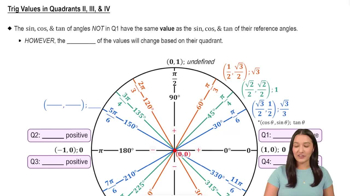
Quadrants and Angle Sign Conventions

The value of trigonometric functions varies by quadrant, affecting the angle's sign and measure. Knowing which quadrant the angle lies in, based on the function and its value, is crucial to correctly interpreting the inverse function's output.
Recommended video:
5:30
Trig Values in Quadrants II, III, & IV