Ch. 7 - Transcendental Functions
Hass - Thomas' Calculus 15th Edition
Hass15th EditionThomas' CalculusISBN: 9780137616077Not the one you use?Change textbook
Chapter 7, Problem 7.6.7a

Use reference triangles in an appropriate quadrant to find the angles in Exercises 1–8.
7. a. sec^(-1)(-√2)

Verified step by step guidance
1
Recall that the function \( \sec^{-1}(x) \) is the inverse secant function, which gives an angle \( \theta \) such that \( \sec(\theta) = x \). The range of \( \sec^{-1}(x) \) is usually taken as \( [0, \pi] \) excluding \( \frac{\pi}{2} \), meaning the angle lies in either the first or second quadrant.
Given \( \sec^{-1}(-\sqrt{2}) \), we want to find an angle \( \theta \) where \( \sec(\theta) = -\sqrt{2} \). Since secant is the reciprocal of cosine, this means \( \cos(\theta) = -\frac{1}{\sqrt{2}} \).
Identify the reference angle by considering the positive value \( \frac{1}{\sqrt{2}} \). The reference angle \( \alpha \) satisfies \( \cos(\alpha) = \frac{1}{\sqrt{2}} \), which corresponds to \( \alpha = \frac{\pi}{4} \) (or 45 degrees).
Since \( \cos(\theta) \) is negative and the angle \( \theta \) must be in the range \( [0, \pi] \) excluding \( \frac{\pi}{2} \), \( \theta \) lies in the second quadrant. Therefore, \( \theta = \pi - \alpha = \pi - \frac{\pi}{4} \).
Express the final answer for \( \sec^{-1}(-\sqrt{2}) \) as \( \theta = \pi - \frac{\pi}{4} \), which is the angle in the appropriate quadrant corresponding to the given inverse secant value.

Verified video answer for a similar problem:

This video solution was recommended by our tutors as helpful for the problem above.
Video duration:
2m
Was this helpful?

Key Concepts

Here are the essential concepts you must grasp in order to answer the question correctly.

Inverse Secant Function (sec⁻¹)

The inverse secant function, sec⁻¹(x), returns the angle whose secant is x. Since secant is the reciprocal of cosine, sec⁻¹(x) finds an angle θ such that sec(θ) = x, with θ typically restricted to specific intervals to ensure a unique value.
Recommended video:
06:35
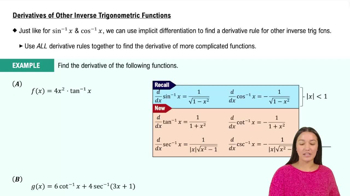
Derivatives of Other Inverse Trigonometric Functions

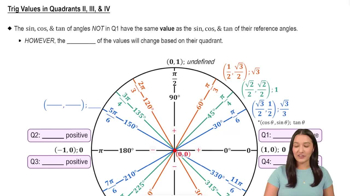
Reference Triangles and Quadrants

Reference triangles help find exact angle measures by relating trigonometric values to known angles in the unit circle. Identifying the correct quadrant is essential because the sign of the trigonometric function determines the angle's location.
Recommended video:
5:30
Trig Values in Quadrants II, III, & IV

Sign of Trigonometric Functions in Quadrants

The sign of secant (and cosine) varies by quadrant: secant is positive in Quadrants I and IV, and negative in Quadrants II and III. For sec⁻¹(-√2), the angle must lie in a quadrant where secant is negative, guiding the selection of the correct reference angle.
Recommended video:
6:04
Introduction to Trigonometric Functions