Ch. 7 - Transcendental Functions
Hass - Thomas' Calculus 15th Edition
Hass15th EditionThomas' CalculusISBN: 9780137616077Not the one you use?Change textbook
Chapter 7, Problem 7.7.71a

Evaluate the integrals in Exercises 67–74 in terms of
a. inverse hyperbolic functions.
71. ∫(from 1/5 to 3/13)dx/(x√(1-16x²))

Verified step by step guidance
1
Identify the integral to be evaluated: \(\int_{\frac{1}{5}}^{\frac{3}{13}} \frac{dx}{x \sqrt{1 - 16x^2}}\).
Recognize that the integrand has the form \(\frac{1}{x \sqrt{1 - a^2 x^2}}\) with \(a = 4\), which suggests using a substitution or a known formula involving inverse hyperbolic functions.
Recall the inverse hyperbolic function identity: \(\operatorname{arcosh}(z) = \ln(z + \sqrt{z^2 - 1})\) and the derivative of \(\operatorname{arcosh}(x)\) is \(\frac{1}{\sqrt{x^2 - 1}}\), but here the integrand involves \(\sqrt{1 - 16x^2}\), so consider the substitution \(x = \frac{1}{4} \sin \theta\) or relate it to \(\operatorname{arcosh}\) or \(\operatorname{arcsinh}\) forms.
Use the substitution \(x = \frac{1}{4} \sin \theta\) to rewrite the integral in terms of \(\theta\), then simplify the integral to a form involving \(\csc \theta\) or \(\cot \theta\), which can be integrated to inverse hyperbolic functions.
After integrating with respect to \(\theta\), back-substitute to express the answer in terms of \(x\), and then evaluate the definite integral by plugging in the limits \(x = \frac{1}{5}\) and \(x = \frac{3}{13}\).

Verified video answer for a similar problem:

This video solution was recommended by our tutors as helpful for the problem above.
Video duration:
4m
Was this helpful?

Key Concepts

Here are the essential concepts you must grasp in order to answer the question correctly.

Inverse Hyperbolic Functions

Inverse hyperbolic functions, such as arsinh, arcosh, and artanh, are the inverses of hyperbolic sine, cosine, and tangent functions. They often appear in integrals involving expressions like √(1 ± x²) or √(x² - 1). Recognizing when to rewrite integrals in terms of these functions simplifies evaluation.
Recommended video:
4:49
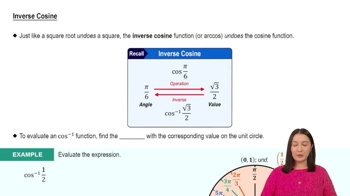
Inverse Cosine

Integration Techniques for Radical Expressions

Integrals involving radicals like √(1 - a²x²) often require substitution or recognition of standard integral forms. Techniques include trigonometric or hyperbolic substitutions that transform the integral into a more manageable form, enabling direct integration.
Recommended video:
06:13
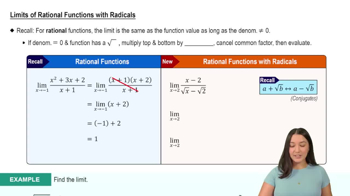
Limits of Rational Functions with Radicals

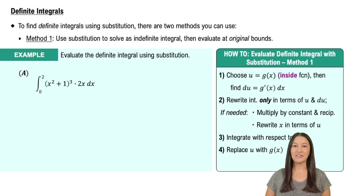
Definite Integration with Substitution

When evaluating definite integrals, substitution changes the variable and the limits accordingly. Properly adjusting the limits after substitution ensures accurate evaluation of the integral over the specified interval.
Recommended video:
06:36
Definite Integrals