Ch. 7 - Transcendental Functions
Hass - Thomas' Calculus 15th Edition
Hass15th EditionThomas' CalculusISBN: 9780137616077Not the one you use?Change textbook
Chapter 7, Problem 7.8.9.a

9. True, or false? As x→∞,
a. x = o(x)

Verified step by step guidance
1
Recall the definition of the little-o notation: For functions \(f(x)\) and \(g(x)\), we say \(f(x) = o(g(x))\) as \(x \to \infty\) if \(\lim_{x \to \infty} \frac{f(x)}{g(x)} = 0\).
In this problem, we are asked whether \(x = o(x)\) as \(x \to \infty\). Here, both \(f(x)\) and \(g(x)\) are the same function \(x\).
Compute the limit \(\lim_{x \to \infty} \frac{x}{x}\). Simplify the fraction first: \(\frac{x}{x} = 1\) for all \(x \neq 0\).
Evaluate the limit: \(\lim_{x \to \infty} 1 = 1\), which is not equal to zero.
Since the limit is not zero, the statement \(x = o(x)\) as \(x \to \infty\) is false.

Verified video answer for a similar problem:

This video solution was recommended by our tutors as helpful for the problem above.
Video duration:
2m
Was this helpful?

Key Concepts

Here are the essential concepts you must grasp in order to answer the question correctly.

Little-o Notation

Little-o notation, written as f(x) = o(g(x)) as x→∞, means that f(x) grows much slower than g(x), or equivalently, the limit of f(x)/g(x) as x approaches infinity is zero. It describes a function that becomes insignificant compared to another function at infinity.
Recommended video:
04:22
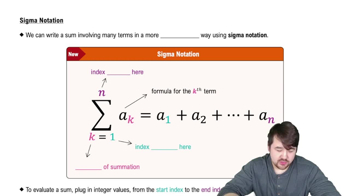
Sigma Notation

Behavior of Functions as x Approaches Infinity

Understanding how functions behave as x approaches infinity is crucial. For example, polynomial functions grow without bound, and comparing their growth rates helps determine relationships like dominance or equivalence in asymptotic notation.
Recommended video:
05:36
Integrals of Natural Exponential Functions (e^x) Example 3

Limit of a Ratio of Functions

Evaluating limits of ratios like f(x)/g(x) as x→∞ helps determine asymptotic relationships. If the limit is zero, f(x) = o(g(x)); if finite and nonzero, f(x) = Θ(g(x)); if infinite, f(x) grows faster than g(x). This concept is key to interpreting little-o notation.
Recommended video:
06:11
Limits of Rational Functions: Denominator = 0