Ch. 7 - Transcendental Functions
Hass - Thomas' Calculus 15th Edition
Hass15th EditionThomas' CalculusISBN: 9780137616077Not the one you use?Change textbook
Chapter 7, Problem 7.6.5a

Use reference triangles in an appropriate quadrant to find the angles in Exercises 1–8.
5. a. arccos(1/2)

Verified step by step guidance
1
Recall that the function arccos(x) gives the angle \( \theta \) whose cosine is \( x \), and its principal value range is \( 0 \leq \theta \leq \pi \) (or 0 to 180 degrees).
Identify the value inside the arccos function: here it is \( \frac{1}{2} \). We want to find \( \theta \) such that \( \cos(\theta) = \frac{1}{2} \).
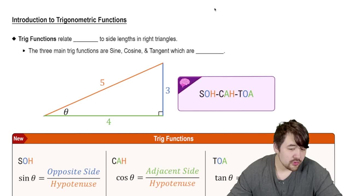
Use a reference triangle to determine the angle with cosine \( \frac{1}{2} \). Recall that in a right triangle, cosine is adjacent over hypotenuse, so the adjacent side is half the hypotenuse.
From common special angles, recognize that \( \cos(\frac{\pi}{3}) = \frac{1}{2} \). Since arccos returns values in the first and second quadrants, the angle is either \( \frac{\pi}{3} \) or \( \pi - \frac{\pi}{3} = \frac{2\pi}{3} \).
Conclude that the principal value of \( \arccos(\frac{1}{2}) \) is \( \frac{\pi}{3} \), and if considering the full range of cosine, the other angle in the second quadrant is \( \frac{2\pi}{3} \).

Verified video answer for a similar problem:

This video solution was recommended by our tutors as helpful for the problem above.
Video duration:
1m
Was this helpful?

Key Concepts

Here are the essential concepts you must grasp in order to answer the question correctly.

Inverse Trigonometric Functions

Inverse trigonometric functions, like arccos, return the angle whose trigonometric ratio matches a given value. For arccos(1/2), it finds the angle whose cosine is 1/2, typically within the principal range of 0 to π radians (0° to 180°). Understanding their ranges is essential to identify correct angle values.
Recommended video:
06:35
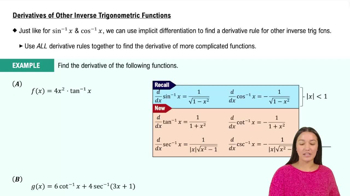
Derivatives of Other Inverse Trigonometric Functions

Reference Triangles

Reference triangles are right triangles used to relate trigonometric ratios to angles in different quadrants. By using the known side ratios, you can find the acute reference angle and then determine the actual angle based on the quadrant specified, ensuring correct angle measurement.
Recommended video:
6:04
Introduction to Trigonometric Functions

Quadrants and Angle Sign Conventions

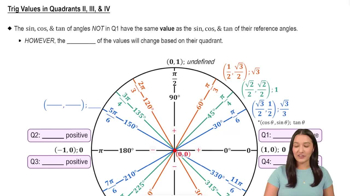
The coordinate plane is divided into four quadrants, each with specific signs for sine, cosine, and tangent. Knowing which quadrant an angle lies in helps determine the correct angle value from the reference angle, especially since cosine is positive in the first and fourth quadrants.
Recommended video:
5:30
Trig Values in Quadrants II, III, & IV