Ch. 7 - Transcendental Functions
Hass - Thomas' Calculus 15th Edition
Hass15th EditionThomas' CalculusISBN: 9780137616077Not the one you use?Change textbook
Chapter 7, Problem 7.8.2.a

2. Which of the following functions grow faster than e^x as x→∞? Which grow at the same rate as e^x? Which grow slower?
a. 10x^4 + 30x + 1

Verified step by step guidance
1
Recall that the function \(e^x\) is an exponential function, which generally grows faster than any polynomial function as \(x \to \infty\).
Identify the given function: \(10x^4 + 30x + 1\), which is a polynomial of degree 4.
Compare the growth rates by considering the limit \(\lim_{x \to \infty} \frac{10x^4 + 30x + 1}{e^x}\).
Since \(e^x\) grows faster than any polynomial, this limit approaches 0, indicating that \(10x^4 + 30x + 1\) grows slower than \(e^x\) as \(x \to \infty\).
Therefore, the function \(10x^4 + 30x + 1\) grows slower than \(e^x\) as \(x\) approaches infinity.

Verified video answer for a similar problem:

This video solution was recommended by our tutors as helpful for the problem above.
Video duration:
4m
Was this helpful?

Key Concepts

Here are the essential concepts you must grasp in order to answer the question correctly.

Growth Rates of Functions

Growth rates describe how functions behave as the input becomes very large. Comparing growth rates helps determine which functions increase faster, slower, or at the same pace as others, especially as x approaches infinity.
Recommended video:
04:16
Intro To Related Rates

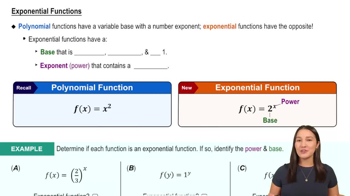
Exponential Functions

Exponential functions like e^x grow by continuously multiplying by a constant base raised to the variable power. They increase faster than any polynomial function as x approaches infinity, making them a benchmark for comparing growth rates.
Recommended video:
6:13
Exponential Functions

Polynomial Functions

Polynomial functions are sums of terms with variables raised to whole number powers, such as 10x^4 + 30x + 1. Their growth rate is dominated by the highest power term and is slower than exponential functions as x approaches infinity.
Recommended video:
07:00
Taylor Polynomials