Ch. 7 - Transcendental Functions
Hass - Thomas' Calculus 15th Edition
Hass15th EditionThomas' CalculusISBN: 9780137616077Not the one you use?Change textbook
Chapter 7, Problem 7.7.67a

Evaluate the integrals in Exercises 67–74 in terms of
a. inverse hyperbolic functions.
67. ∫(from 0 to 2√3)dx/√(4+x²)

Verified step by step guidance
1
Recognize that the integral \( \int \frac{dx}{\sqrt{a^2 + x^2}} \) can be expressed in terms of the inverse hyperbolic sine function, \( \sinh^{-1}(x/a) \), where \( a \) is a constant.
Identify the constant \( a \) in the integral. Here, the integral is \( \int_0^{2\sqrt{3}} \frac{dx}{\sqrt{4 + x^2}} \), so \( a^2 = 4 \) which means \( a = 2 \).
Rewrite the integral using the formula: \( \int \frac{dx}{\sqrt{a^2 + x^2}} = \sinh^{-1}\left( \frac{x}{a} \right) + C \). For the definite integral, evaluate \( \sinh^{-1}\left( \frac{x}{2} \right) \) from 0 to \( 2\sqrt{3} \).
Set up the evaluation: compute \( \sinh^{-1}\left( \frac{2\sqrt{3}}{2} \right) - \sinh^{-1}\left( \frac{0}{2} \right) \). Simplify the arguments inside the inverse hyperbolic sine functions.
Recall that \( \sinh^{-1}(y) = \ln\left(y + \sqrt{y^2 + 1}\right) \) if you want to express the answer in logarithmic form, but since the problem asks for inverse hyperbolic functions, leave the answer in terms of \( \sinh^{-1} \).

Verified video answer for a similar problem:

This video solution was recommended by our tutors as helpful for the problem above.
Video duration:
2m
Was this helpful?

Key Concepts

Here are the essential concepts you must grasp in order to answer the question correctly.

Inverse Hyperbolic Functions

Inverse hyperbolic functions, such as sinh⁻¹(x) and cosh⁻¹(x), are the inverses of hyperbolic sine and cosine functions. They often appear in integrals involving expressions like √(a² + x²). Recognizing these forms allows rewriting integrals in terms of inverse hyperbolic functions for simpler evaluation.
Recommended video:
4:49
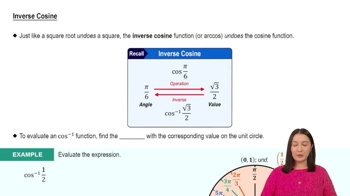
Inverse Cosine

Integration of Rational Functions Involving Square Roots

Integrals containing expressions like 1/√(a² + x²) are common and can be solved using substitution or by recalling standard integral formulas. These integrals typically result in inverse hyperbolic functions, making it essential to identify the pattern to apply the correct formula efficiently.
Recommended video:
07:01
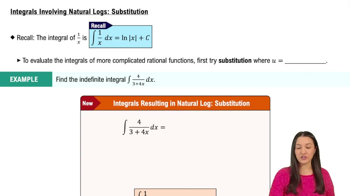
Integrals Involving Natural Logs: Substitution

Definite Integration and Evaluation of Limits

Definite integrals require evaluating the antiderivative at the upper and lower limits. After finding the integral in terms of inverse hyperbolic functions, substituting the limits correctly and simplifying the result is crucial to obtain the final numerical value.
Recommended video:
05:43
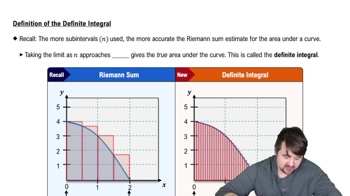
Definition of the Definite Integral