Back
Back
Problem 7
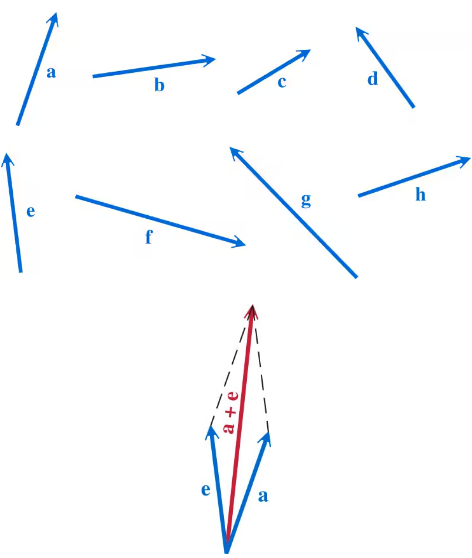
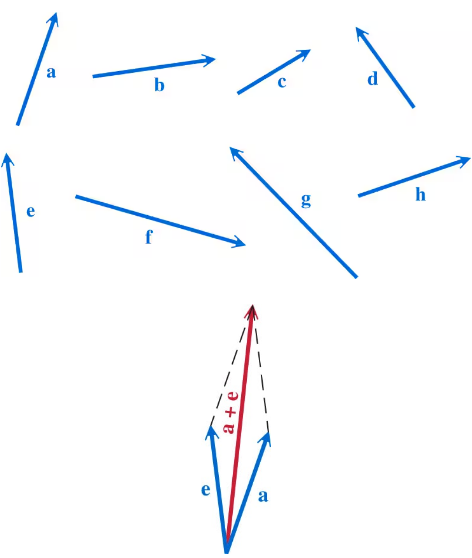
CONCEPT PREVIEW Refer to vectors a through h below. Make a copy or a sketch of each vector, and then draw a sketch to represent each of the following. For example, find a + e by placing a and e so that their initial points coincide. Then use the parallelogram rule to find the resultant, as shown in the figure on the right.
2c
Problem 9
Refer to vectors a through h below. Make a copy or a sketch of each vector, and then draw a sketch to represent each of the following. For example, find a + e by placing a and e so that their initial points coincide. Then use the parallelogram rule to find the resultant, as shown in the figure on the right.
a + b
Problem 13
Refer to vectors a through h below. Make a copy or a sketch of each vector, and then draw a sketch to represent each of the following. For example, find a + e by placing a and e so that their initial points coincide. Then use the parallelogram rule to find the resultant, as shown in the figure on the right.
<IMAGE>
a + (b + c)
Problem 15
Refer to vectors a through h below. Make a copy or a sketch of each vector, and then draw a sketch to represent each of the following. For example, find a + e by placing a and e so that their initial points coincide. Then use the parallelogram rule to find the resultant, as shown in the figure on the right.
<IMAGE>
c + d
Problem 19
For each pair of vectors u and v with angle θ between them, sketch the resultant.
|u| = 12, |v| = 20, θ = 27°
Problem 21
For each pair of vectors u and v with angle θ between them, sketch the resultant.
|u| = 20, |v| = 30, θ = 30°
Problem 23
Use the parallelogram rule to find the magnitude of the resultant force for the two forces shown in each figure. Round answers to the nearest tenth.
<IMAGE>
Problem 25
Use the parallelogram rule to find the magnitude of the resultant force for the two forces shown in each figure. Round answers to the nearest tenth.
<IMAGE>
Problem 27
Two forces act on a point in the plane. The angle between the two forces is given. Find the magnitude of the resultant force.
forces of 250 and 450 newtons, forming an angle of 85°
Problem 29
Two forces act on a point in the plane. The angle between the two forces is given. Find the magnitude of the resultant force.
forces of 116 and 139 lb, forming an angle of 140° 50′
Problem 31
Two tugboats are pulling a disabled speedboat into port with forces of 1240 lb and 1480 lb. The angle between these forces is 28.2°. Find the direction and magnitude of the equilibrant.
Problem 32
Two rescue vessels are pulling a broken-down motorboat toward a boathouse with forces of 840 lb and 960 lb. The angle between these forces is 24.5°. Find the direction and magnitude of the equilibrant.
Problem 33
Two forces of 692 newtons and 423 newtons act on a point. The resultant force is 786 newtons. Find the angle between the forces.
Problem 34
Two forces of 128 lb and 253 lb act on a point. The resultant force is 320 lb. Find the angle between the forces.
Problem 35
A force of 176 lb makes an angle of 78° 50′ with a second force. The resultant of the two forces makes an angle of 41° 10′ with the first force. Find the magnitudes of the second force and of the resultant.
<IMAGE>
Problem 36
A force of 28.7 lb makes an angle of 42° 10′ with a second force. The resultant of the two forces makes an angle of 32° 40′ with the first force. Find the magnitudes of the second force and of the resultant.
<IMAGE>
Problem 37
A force of 25 lb is required to hold an 80-lb crate on a hill. What angle does the hill make with the horizontal?
Problem 38
Find the force required to keep a 3000-lb car parked on a hill that makes an angle of 15° with the horizontal.
Problem 39
To build the pyramids in Egypt, it is believed that giant causeways were constructed to transport the building materials to the site. One such causeway is said to have been 3000 ft long, with a slope of about 2.3°. How much force would be required to hold a 60-ton monolith on this causeway?
<IMAGE>
Problem 41
A force of 18.0 lb is required to hold a 60.0-lb stump grinder on an incline. What angle does the incline make with the horizontal?
Problem 42
A force of 30.0 lb is required to hold an 80.0-lb pressure washer on an incline. What angle does the incline make with the horizontal?
Problem 43
Two people are carrying a box. One person exerts a force of 150 lb at an angle of 62.4° with the horizontal. The other person exerts a force of 114 lb at an angle of 54.9°. Find the weight of the box.
<IMAGE>
Problem 44
A crate is supported by two ropes. One rope makes an angle of 46° 20′ with the horizontal and has a tension of 89.6 lb on it. The other rope is horizontal. Find the weight of the crate and the tension in the horizontal rope.
Problem 45
A ship leaves port on a bearing of 34.0° and travels 10.4 mi. The ship then turns due east and travels 4.6 mi. How far is the ship from port, and what is its bearing from port?
Problem 46
A luxury liner leaves port on a bearing of 110.0° and travels 8.8 mi. It then turns due west and travels 2.4 mi. How far is the liner from port, and what is its bearing from port?
Problem 47
Starting at point A, a ship sails 18.5 km on a bearing of 189°, then turns and sails 47.8 km on a bearing of 317°. Find the distance of the ship from point A.
Problem 48
Starting at point X, a ship sails 15.5 km on a bearing of 200°, then turns and sails 2.4 km on a bearing of 320°. Find the distance of the ship from point X.
Problem 49
Solve each problem. See Examples 5 and 6.
Distance and Direction of a Motorboat A motorboat sets out in the direction N 80° 00′ E. The speed of the boat in still water is 20.0 mph. If the current is flowing directly south, and the actual direction of the motorboat is due east, find the speed of the current and the actual speed of the motorboat.
<IMAGE>
Problem 51
Solve each problem. See Examples 5 and 6.
Bearing and Ground Speed of a Plane An airline route from San Francisco to Honolulu is on a bearing of 233.0°. A jet flying at 450 mph on that bearing encounters a wind blowing at 39.0 mph from a direction of 114.0°. Find the resulting bearing and ground speed of the plane.
Problem 54
A plane flies 650 mph on a bearing of 175.3°. A 25-mph wind, from a direction of 266.6°, blows against the plane. Find the resulting bearing of the plane.