Ch. 7 - Applications of Trigonometry and Vectors
Lial - Trigonometry 12th Edition
Lial12th EditionTrigonometryISBN: 9780136552161Not the one you use?Change textbook
Chapter 8, Problem 13

Refer to vectors a through h below. Make a copy or a sketch of each vector, and then draw a sketch to represent each of the following. For example, find a + e by placing a and e so that their initial points coincide. Then use the parallelogram rule to find the resultant, as shown in the figure on the right.


<IMAGE>


a + (b + c)

Verified step by step guidance
1
Begin by sketching each of the vectors \( \mathbf{a} \), \( \mathbf{b} \), and \( \mathbf{c} \) separately, paying attention to their directions and magnitudes as given or implied in the problem.
Next, focus on the expression inside the parentheses: \( \mathbf{b} + \mathbf{c} \). To add these two vectors, place the initial point of \( \mathbf{c} \) at the terminal point of \( \mathbf{b} \).
Use the parallelogram rule or the tip-to-tail method to find the resultant vector \( \mathbf{b} + \mathbf{c} \). This resultant vector starts at the initial point of \( \mathbf{b} \) and ends at the terminal point of \( \mathbf{c} \) after placement.
Now, to find \( \mathbf{a} + (\mathbf{b} + \mathbf{c}) \), place the initial point of the resultant vector \( \mathbf{b} + \mathbf{c} \) at the terminal point of \( \mathbf{a} \).
Finally, draw the resultant vector starting from the initial point of \( \mathbf{a} \) to the terminal point of \( \mathbf{b} + \mathbf{c} \) after placement. This vector represents \( \mathbf{a} + (\mathbf{b} + \mathbf{c}) \).

Verified video answer for a similar problem:

This video solution was recommended by our tutors as helpful for the problem above.
Was this helpful?

Key Concepts

Here are the essential concepts you must grasp in order to answer the question correctly.

Vector Addition

Vector addition involves combining two or more vectors to find a resultant vector. This is done by placing the initial point of one vector at the terminal point of another and then drawing the resultant from the start of the first to the end of the last vector. It follows the commutative and associative properties.
Recommended video:
05:29
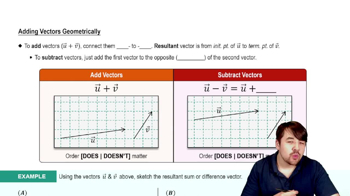
Adding Vectors Geometrically

Parallelogram Rule

The parallelogram rule is a geometric method to add two vectors. By placing both vectors so their initial points coincide, a parallelogram is formed using the vectors as adjacent sides. The diagonal of this parallelogram from the common initial point represents the resultant vector.
Recommended video:
5:08
Sine, Cosine, & Tangent of 30°, 45°, & 60°

Associative Property of Vector Addition

The associative property states that when adding three or more vectors, the grouping does not affect the resultant vector. For example, a + (b + c) equals (a + b) + c. This property allows flexibility in how vectors are combined and simplifies calculations.
Recommended video:
05:29
Adding Vectors Geometrically